How Long Until 3:00 PM? Calculate the Exact Time Remaining Today
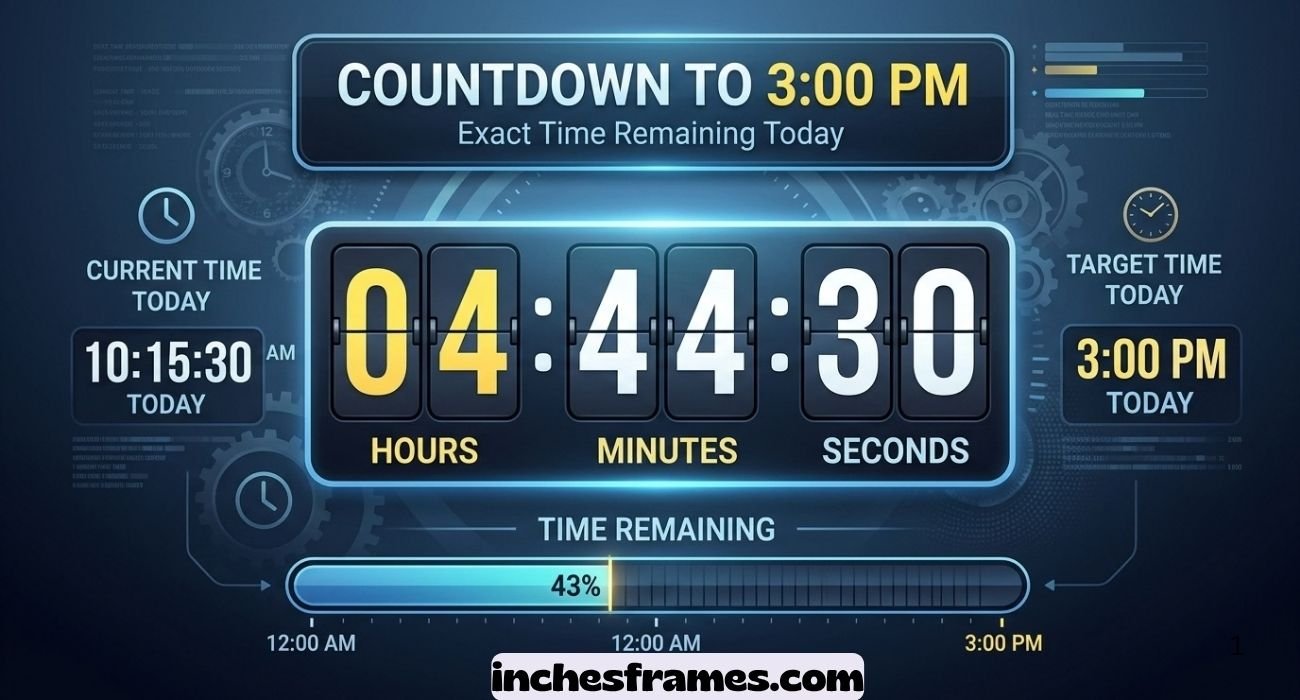
If you are wondering how long until 3:00 PM, the exact answer depends on the current time where you are. For example, if it is 10:00 AM, there are 5 hours until 3:00 PM. If it is 2:30 PM, only 30 minutes remain.
The basic calculation is simple:
Time remaining = 3:00 PM − current local time
In the United States, the answer can also depend on your local time zone, especially when people in different parts of the country are checking the same scheduled event.
This guide explains how to calculate the exact time until 3 PM in hours, minutes, and seconds, what to do when 3 PM has already passed, how countdown timers work, and how a 3 PM target can fit into everyday schedules.
Why Do So Many People Wonder: How Long Until 3:00 PM?
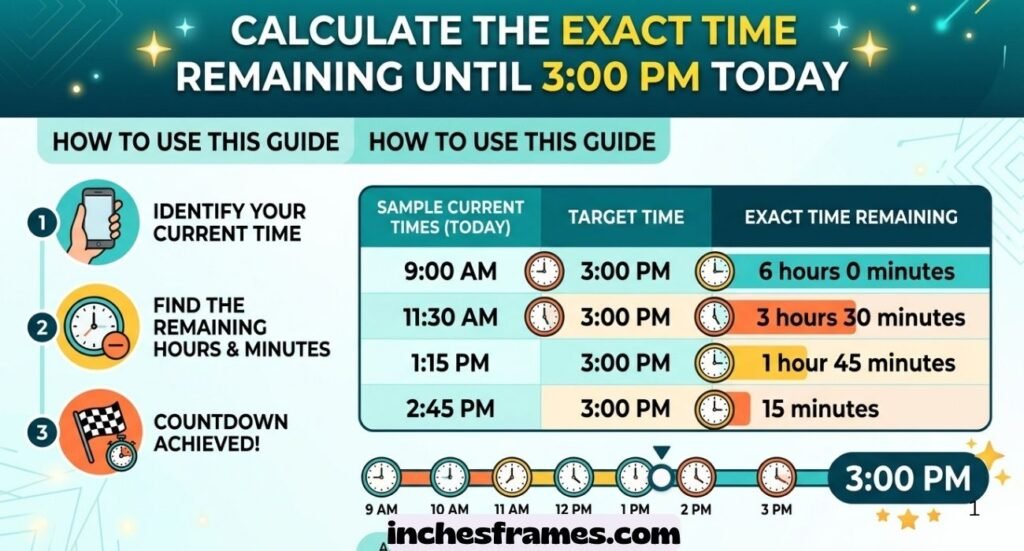
Three o’clock in the afternoon is a common point of reference in a daily schedule. A person might have a meeting at 3 PM, finish work at that time, need to leave for an appointment, or simply want to know how much of the afternoon remains.
The question “How long until 3 PM?” is really a request for a time difference. You have a starting point—the current time—and a target point, which is 3:00 PM. Subtracting the first from the second gives the amount of time remaining.
The question can also appear in several natural forms, including “how many hours until 3 PM,” “how long until 3:00 PM today,” “how much time until 3 PM,” and “what is the countdown to 3 PM?” These searches have essentially the same purpose: finding the remaining duration before the afternoon target arrives.
The answer changes continuously. At 9:00 AM, six hours remain. At 1:00 PM, two hours remain. At 2:59 PM, just one minute remains.
That is why a live countdown timer can be more useful than a single static answer.
Understanding the Countdown to 3 PM
A countdown to 3 PM measures the amount of time between the present moment and 3:00 PM.
What Time Is 3:00 PM?
3:00 PM is an afternoon time. On a 24-hour clock, it is written as 15:00.
The AM/PM system divides the day into two 12-hour periods. In that system:
- 3:00 AM is three hours after midnight.
- 3:00 PM is three hours after noon.
Confusing 3 AM with 3 PM is one of the simplest ways to get a countdown wrong. When calculating a daytime appointment, deadline, or event at 3 PM, the target is 15:00, not 03:00.
What Does “Until 3 PM” Mean?
“Until 3 PM” normally means the amount of time remaining before the clock reaches 3:00 PM.
Suppose the current time is 12:20 PM. The target is 3:00 PM. From 12:20 PM to 1:20 PM is one hour, from 1:20 PM to 2:20 PM is another hour, and from 2:20 PM to 3:00 PM is 40 minutes.
Therefore, the remaining time is 2 hours and 40 minutes.
Why the Exact Countdown Changes Every Minute
A countdown is not a fixed number for the entire day. Every passing minute changes the result.
At exactly 2:00 PM, one hour remains. At 2:30 PM, 30 minutes remain. At 2:59 PM, one minute remains.
If seconds are included, the value changes every second. For example, at 2:59:30 PM, there are 30 seconds until 3:00 PM.
This is why a time calculator that uses the current clock time can provide a more precise result than a manually calculated estimate.
How Long Until 3:00 PM Today Depends on the Current Time
There is no single answer to how long until 3:00 PM today unless the current time is known.
Here are some straightforward examples:
| Current Time | Time Remaining Until 3:00 PM |
|---|---|
| 8:00 AM | 7 hours |
| 9:00 AM | 6 hours |
| 10:00 AM | 5 hours |
| 11:00 AM | 4 hours |
| 12:00 PM | 3 hours |
| 12:30 PM | 2 hours 30 minutes |
| 1:00 PM | 2 hours |
| 1:30 PM | 1 hour 30 minutes |
| 2:00 PM | 1 hour |
| 2:15 PM | 45 minutes |
| 2:30 PM | 30 minutes |
| 2:45 PM | 15 minutes |
| 2:59 PM | 1 minute |
| 3:00 PM | 0 minutes |
These examples assume the current time and 3 PM are on the same calendar day.
What If It Is Already After 3 PM?
If the current time is 4:00 PM, today’s 3 PM has already occurred. There is no remaining time until today’s 3 PM because that target has passed.
If you mean the next occurrence of 3 PM, the target moves to 3:00 PM on the following day.
For example, at exactly 4:00 PM, the next 3 PM is 23 hours away. At 8:00 PM, the next 3 PM is 19 hours away.
This distinction matters for automated countdown timers. A timer needs to know whether you want today’s target or the next occurrence of the target.
What If It Is Exactly 3 PM?
At exactly 3:00 PM, the countdown to that day’s target is zero.
If you are asking for the next 3 PM after that moment, the next target is tomorrow at 3:00 PM.
The Mathematics Behind a Time Difference
Calculating the time until 3 PM is basic time subtraction, but using a consistent method helps prevent mistakes.
Simple Formula for Calculating Time Until 3 PM
When the current time is earlier than 3 PM on the same day:
Time remaining = 3:00 PM − current time
For example:
3:00 PM − 1:20 PM = 1 hour 40 minutes
Another example:
3:00 PM − 10:45 AM = 4 hours 15 minutes
The important part is keeping the AM and PM periods straight.
Converting Time Into Minutes
For more complicated calculations, converting times into total minutes can make the arithmetic easier.
A day contains:
24 hours × 60 minutes = 1,440 minutes
3:00 PM is 15:00 in the 24-hour system. Converting 15 hours into minutes gives:
15 × 60 = 900 minutes
So 3:00 PM is 900 minutes after midnight.
If the current time is 1:40 PM, it is 13 hours and 40 minutes after midnight:
13 × 60 + 40 = 820 minutes
Subtract:
900 − 820 = 80 minutes
Therefore:
80 minutes = 1 hour 20 minutes
So at 1:40 PM, there are 1 hour and 20 minutes until 3 PM.
Calculating Seconds Until 3 PM
The same principle works when seconds matter.
There are:
60 seconds in one minute
and:
3,600 seconds in one hour
Suppose the current time is 2:58:20 PM. The target is 3:00:00 PM.
The difference is:
1 minute 40 seconds
or:
100 seconds
A digital countdown can continue reducing that number until it reaches zero.
Crossing Midnight Requires a Different Calculation
If the target time is later than midnight, the calculation needs to account for the change of date.
For example, if it is 11:00 PM and you want to know how long until the next 3:00 PM, you cannot simply subtract 11 PM from 3 PM.
There are 16 hours from 11 PM to the following 3 PM:
1 hour until midnight + 15 hours from midnight to 3 PM = 16 hours
This is an important distinction between a same-day countdown and a countdown to the next occurrence of a time.
Popular Countdown Times Around 3 PM
People often use 3 PM as one point in a broader afternoon schedule. Nearby times can also serve as useful checkpoints.
How Long Until 2 PM?
If the current time is before 2 PM, subtract the current time from 2:00 PM.
For example, at 11:30 AM, there are 2 hours and 30 minutes until 2 PM.
How Long Until 2:30 PM?
A 2:30 PM target is useful when an appointment or task falls halfway between 2 PM and 3 PM.
At 1:15 PM, there are 1 hour and 15 minutes until 2:30 PM.
How Long Until 3 PM?
The primary target is 3:00 PM.
At 12:00 PM, three hours remain. At 1:30 PM, one hour and 30 minutes remain. At 2:45 PM, only 15 minutes remain.
How Long Until 3:30 PM?
Once 3 PM passes, some people may be interested in the next half-hour checkpoint.
At 2:00 PM, there are 90 minutes until 3:30 PM.
How Long Until 4 PM?
4 PM is another common afternoon reference point. If it is 1 PM, there are three hours until 4 PM.
These nearby targets can be useful when planning a sequence of tasks rather than watching one specific time.
See Also : How Long Until 3:30? Calculate the Exact Time Remaining Today
Best Tools for Tracking the Time Until 3 PM
You do not have to calculate every countdown manually. Several types of digital tools can determine the remaining time automatically.
Online Countdown Timers
An online countdown timer can display the remaining hours, minutes, and seconds until a specified target.
For a simple 3 PM countdown, the timer needs to know the current date, current local time, and target time. A well-designed timer should also handle the transition from one day to the next.
Smartphone Clock and Timer Apps
Most smartphones provide clock, alarm, and timer functions. An alarm can notify you when 3 PM arrives, while a countdown timer can show how much time remains.
These are different functions. An alarm answers “when should I be notified?” A countdown answers “how much time is left?”
Calendar and Scheduling Apps
A calendar application is particularly useful when 3 PM represents an actual event rather than an arbitrary time.
For example, a 3 PM appointment can be entered as a calendar event with a reminder before the scheduled start. The calendar handles the event date and time, while a separate countdown can show the remaining duration.
Digital Clock Widgets
A digital clock or clock widget can make the current local time immediately visible. This is helpful when you regularly need to calculate how much time remains until a recurring afternoon event.
A Dedicated “How Long Until 3 PM?” Calculator
A purpose-built time calculator can make the process even simpler. Ideally, it should automatically use the current local date and time, identify 3 PM as the target, and update the result continuously.
A useful calculator should also handle the important edge cases: exactly 3 PM, a current time after 3 PM, the following day, and changes in the local clock.
How Long Until 3 PM and Productivity
A 3 PM countdown can be more than a curiosity. It can act as a simple time-management checkpoint.
Using 3 PM as a Workday Checkpoint
Suppose you have several tasks to complete before the late afternoon. Knowing that two hours remain until 3 PM gives you a concrete window in which to work.
Instead of thinking, “I have some time left,” you can work with a specific duration such as 2 hours and 10 minutes.
That can make it easier to decide which task belongs in the available window and which task should be scheduled later.
Breaking Work Into Smaller Time Blocks
A long period can be divided into smaller blocks.
For example, if it is 12 PM and your target is 3 PM, you have three hours. You might use the first hour for focused work, the second for another task, and the final hour for review or preparation.
The calculation itself does not improve productivity automatically. Its value is that it gives you a clear boundary for planning.
Using 3 PM as a Progress Check
A recurring 3 PM checkpoint can also help you review what has been completed during the day.
If a task was expected to be finished by 3 PM, the countdown provides a simple way to see how much time remains before that checkpoint.
Scheduling Around 3:00 PM
A precise scheduled event requires more than knowing that something happens “in the afternoon.” The exact time matters.
Meetings at 3 PM
If a meeting begins at 3 PM, the countdown can help you decide when to finish the current task, gather documents, or move to the meeting location.
For a remote meeting, it can also provide a reminder to check the meeting link and equipment before the start time.
School and Study Schedules
Students may use 3 PM as the end of a study block, the beginning of an activity, or a transition between parts of the day.
If it is 1:30 PM, for example, there are exactly 90 minutes until 3 PM. That gives a clear maximum window for the current activity.
Travel and Commutes
When an appointment starts at 3 PM, the relevant question may not simply be “how long until 3 PM?” You may also need to account for travel time.
If a journey is expected to take 40 minutes and you want to arrive 10 minutes early, the departure target is 50 minutes before 3 PM.
That means the practical deadline is 2:10 PM, not 3 PM.
Work Deadlines
A 3 PM deadline can be converted into smaller checkpoints. If it is 1 PM, two hours remain. If a task requires approximately 75 minutes, there is theoretically 45 minutes left after the task—but real schedules may also need time for interruptions, review, or submission.
A countdown tells you the available duration; it does not guarantee that a task will fit into that duration.
Appointments and Reminders
A calendar reminder is often better than relying entirely on memory. A countdown and reminder serve different purposes: the countdown measures remaining time, while the reminder creates a notification at a chosen point.
Cultural Rituals of Afternoon Time
Three o’clock can have different meanings depending on a person’s schedule, workplace, school, or daily routine. There is no single American routine that applies to everyone.
For some people, 3 PM is a workday checkpoint. For others, it may be the end of a school period, an appointment time, a break, or simply an arbitrary reference point.
Afternoon Breaks
People often organize parts of the afternoon around breaks or changes in activity. A 3 PM target can provide a clear boundary between one part of the day and another.
The usefulness of the time depends on the individual’s schedule rather than on 3 PM having a universal meaning.
The 3 PM Workday Checkpoint
For someone working a conventional daytime schedule, 3 PM may feel like a recognizable late-afternoon milestone. Someone with an evening, overnight, flexible, or irregular schedule may use a completely different reference time.
This is why a local time calculation is more useful than assuming everyone follows the same timetable.
Food and Beverage Routines
Afternoon snacks, coffee breaks, or other personal routines may also happen around the same time each day. A recurring reminder at 3 PM can make these routines easier to remember.
The important point is that the clock provides a fixed reference even when daily activities vary.
Different Schedules Across the United States
The United States covers multiple time zones, including Eastern, Central, Mountain, and Pacific time, along with additional zones and territories.
As a result, a 3 PM event in New York does not occur at the same moment as 3 PM on the West Coast. Both locations can show 3 PM on their local clocks at different moments in absolute time.
For a local countdown, the correct time zone is therefore essential.
See Also : : How Long Until 2:30 PM? Calculate the Exact Time Remaining Today
Waiting Is More Emotional Than Mathematical
The mathematics of a countdown is objective, but people’s experience of waiting can vary.
A clock might say that 10 minutes remain, yet those 10 minutes can feel short when someone is busy and much longer when they are watching the clock.
A precise countdown can still be useful because it replaces an uncertain question such as “When will 3 PM finally arrive?” with a measurable duration.
Why Five Minutes Can Feel Long
If you are focused on a task, five minutes may pass without much attention. If you are waiting for an appointment or event, you may notice each minute.
The actual passage of time is the same. What changes is the person’s attention to it.
Why Knowing the Exact Remaining Time Helps
Knowing that 15 minutes remain until 3 PM provides a more useful planning reference than simply knowing that 3 PM is “later.”
You can decide whether to start something that takes 10 minutes, finish a short task, or prepare for the upcoming event.
Countdown vs. Clock Watching
Repeatedly checking a clock requires you to interrupt whatever you are doing. A countdown display can provide the remaining duration at a glance.
For short waits, this is a simple convenience. For scheduled work, it can also provide a clear boundary for a task.
How Digital Countdown Systems Work
A digital countdown is essentially a calculation performed repeatedly using time values.
Getting the Current Time
A device or website first determines the current date and time. For a local countdown, this should correspond to the user’s intended time zone.
Identifying the Target Time
The target is set to 3:00 PM. The system also needs to determine which date applies.
If it is 11 AM today, today’s 3 PM is the target. If it is 5 PM and the user wants the next occurrence, tomorrow’s 3 PM becomes the target.
Calculating the Difference
The system compares the current timestamp with the target timestamp.
Conceptually:
Target timestamp − current timestamp = remaining duration
The result can then be expressed as hours, minutes, and seconds.
Updating the Countdown
A live timer repeatedly recalculates or updates the displayed duration. If the display shows 2 hours, 14 minutes, and 30 seconds, one second later the remaining duration is one second shorter.
Small differences can occur between a displayed countdown and the actual wall clock because devices, browsers, networks, and page updates do not all operate with perfectly synchronized timing.
Handling Time Zones and Daylight Saving Time
Time zones become especially important when an event is being planned across locations.
For example, an event scheduled for 3 PM Eastern Time occurs at a different absolute moment from an event scheduled for 3 PM Pacific Time.
Daylight saving time can also change the relationship between local clock times and Coordinated Universal Time (UTC) during periods when a location changes its clock.
For ordinary same-location countdowns, users generally only need to ensure that the device’s date, time, and time-zone settings are correct.
Everyday Situations Where a 3 PM Countdown Helps
The question how long until 3 PM can arise in many ordinary situations.
Before a 3 PM Meeting
A countdown can show exactly how much preparation time remains. If 45 minutes are left, you know there is enough time for a short task but perhaps not enough for a long one.
Before a Work Deadline
If a report is due at 3 PM, the countdown gives you a clear remaining window. You can use that window to divide the remaining work into drafting, checking, and submitting.
Waiting for a 3 PM Appointment
Instead of repeatedly calculating the difference mentally, a timer can show the remaining hours and minutes continuously.
Planning an Afternoon Errand
Suppose a store visit and travel require 90 minutes and you need to be finished by 3 PM. If it is 1 PM, the available window is two hours, leaving a 30-minute margin in this simplified example.
Studying Before an Afternoon Event
If an event begins at 3 PM and it is 12:30 PM, there are 2 hours and 30 minutes available. That can be divided into study time and preparation time.
Cooking or Preparing for a 3 PM Event
A fixed target can be used to work backward. If preparation takes 45 minutes, the preparation should begin no later than 2:15 PM if there are no additional buffer requirements.
Tracking a Personal Daily Routine
A recurring 3 PM target can become a simple daily checkpoint for work, study, exercise, errands, or another routine.
How to Calculate the Time Until 3 PM From Any Current Time
The easiest way to find how long until 3 PM is to compare the current time with 3:00 PM. If the current time is before 3 PM, subtract the hours and minutes directly. For example, if it is 11:20 AM, there are 3 hours and 40 minutes remaining until 3 PM.
For more precise results, include minutes and seconds in the calculation. At 2:45 PM, 15 minutes remain, while at 2:59:30 PM, only 30 seconds are left. This simple method works for most same-day countdown calculations.
What Happens When 3 PM Has Already Passed?
If the current time is later than 3 PM, today’s 3 PM has already passed. In that situation, a countdown asking for the next 3 PM should use 3:00 PM on the following day as its target instead of producing a negative time.
For example, if it is 5 PM, the next 3 PM is 22 hours away. Understanding this date change is important when using a digital countdown, scheduling an event, or calculating time remaining until 3 PM automatically.
How Many Minutes Are Left Until 3 PM?
Converting the remaining time into minutes can make a 3 PM countdown easier to understand. If it is 1:00 PM, there are 120 minutes until 3 PM. At 2:30 PM, only 30 minutes remain, and at 2:55 PM, there are just five minutes left.
This format is particularly useful for short deadlines and appointments. Instead of saying that 3 PM is “soon,” an exact figure such as 15 minutes or 10 minutes gives you a clearer idea of the available time.
How Time Zones Affect the 3 PM Countdown
A time zone matters whenever the 3 PM target is connected to a particular location. Three o’clock in New York and three o’clock in Los Angeles occur at different moments, even though both clocks display 3:00 PM locally.
For a personal countdown, the correct local date, time, and time-zone settings should be used. This becomes especially important for online meetings, travel plans, remote work, and other events involving people in different parts of the United States.
Using a 3 PM Countdown to Plan Your Afternoon
A countdown timer can turn 3 PM into a useful afternoon checkpoint. If you know that two hours remain, you can estimate how much work, preparation, travel, or study can reasonably fit into that period instead of relying on a vague sense of how much time is available.
The same approach can be used for smaller tasks. If 30 minutes remain until 3 PM, you might finish a short assignment or prepare for an upcoming appointment. The countdown does not determine what you should do, but it gives you an accurate time boundary for making your own schedule.
Quick Reference: How Long Until 3 PM?
If the current time is exactly one of the times below, the corresponding duration is:
| Current Local Time | Time Until 3:00 PM |
|---|---|
| 8:00 AM | 7 hours |
| 9:00 AM | 6 hours |
| 10:00 AM | 5 hours |
| 11:00 AM | 4 hours |
| 12:00 PM | 3 hours |
| 1:00 PM | 2 hours |
| 1:30 PM | 1 hour 30 minutes |
| 2:00 PM | 1 hour |
| 2:15 PM | 45 minutes |
| 2:30 PM | 30 minutes |
| 2:45 PM | 15 minutes |
| 2:50 PM | 10 minutes |
| 2:55 PM | 5 minutes |
| 2:59 PM | 1 minute |
| 3:00 PM | 0 minutes |
These are fixed examples, not a live countdown. If your current time falls between the listed examples, calculate the difference using the same method.
Frequently Asked Questions About How Long Until 3 PM
How long until 3:00 PM today?
The exact amount of time until 3:00 PM depends on the current local time. For example, at 1:00 PM, two hours remain; at 2:30 PM, 30 minutes remain.
How many hours until 3 PM?
Subtract the current time from 3:00 PM. If it is 10:00 AM, there are five hours. If it is 12:30 PM, there are two hours and 30 minutes.
How many minutes until 3 PM?
Convert the difference into minutes. For example, from 2:15 PM to 3 PM is 45 minutes, while from 1:30 PM to 3 PM is 90 minutes.
What time is 3 PM in 24-hour time?
3 PM is 15:00 on a 24-hour clock.
What if it is already after 3 PM?
Today’s 3 PM has already passed. If you mean the next 3 PM, use 3:00 PM on the following calendar day as the target.
Does the countdown to 3 PM change by location?
Yes. A local countdown depends on the time zone and local clock. Three PM Eastern Time and 3 PM Pacific Time occur at different moments.
Is 3 PM afternoon or evening?
3 PM is generally considered afternoon. The exact boundaries people use for “afternoon” and “evening” can vary in everyday speech, but 3 PM is normally described as an afternoon time.
How do I calculate the time until 3 PM manually?
Use the current time as the starting point and 3:00 PM as the target. For example, if it is 12:40 PM, count from 12:40 PM to 1:40 PM for one hour, then another hour to 2:40 PM, followed by 20 minutes to 3 PM. The answer is 2 hours and 20 minutes.
Can I calculate the exact seconds until 3 PM?
Yes. If you know the current time including seconds, subtract the current timestamp from the 3 PM target. For example, at 2:59:20 PM, there are 40 seconds until 3:00 PM.
What happens to a countdown when the date changes?
If the target is the next occurrence of 3 PM and the current time passes 3 PM, the target moves to 3 PM on the following day. This prevents a countdown from becoming negative when the user actually wants the next occurrence.
Conclusion: Finding the Exact Time Until 3 PM
The answer to how long until 3:00 PM is always tied to the current local time. Before 3 PM on the same day, subtract the current time from 3:00 PM. At 3 PM, the countdown reaches zero. After 3 PM, today’s target has passed, so a countdown to the next occurrence uses 3 PM on the following day.
For quick calculations, remember that 1 hour equals 60 minutes, 1 minute equals 60 seconds, and 3 PM is 15:00 on a 24-hour clock.
Whether you are preparing for a meeting, managing a deadline, planning an afternoon appointment, studying, or simply waiting for a particular time, an accurate countdown turns 3 PM into a clear and measurable target. The most precise answer always comes from comparing the target time with the current local time, including the correct date and time zone when necessary.