How Long Until 2:45 PM? Calculate the Time Remaining Today
If you are wondering how long until 2:45 PM, the exact answer depends on your current local time. For example, if it is 12:00 PM, there are 2 hours and 45 minutes left. If it is 2:30 PM, only 15 minutes remain.
The easiest way to calculate the time until 2:45 PM is to compare your current time with 2:45 PM, which is 14:45 on a 24-hour clock. If 2:45 PM has already passed, the next occurrence is normally tomorrow at 2:45 PM.
This guide explains how to calculate the remaining hours, minutes, and seconds, how to handle AM and PM correctly, what changes across time zones, and how a countdown timer can make the calculation automatic.
How Long Until 2:45 PM Today?
There is no single countdown value that applies to everyone because the answer changes every minute. Your current time determines how long remains.
Here are some simple examples:
| Current Local Time | Time Until 2:45 PM | Minutes Remaining |
|---|---|---|
| 8:00 AM | 6 hours 45 minutes | 405 minutes |
| 9:00 AM | 5 hours 45 minutes | 345 minutes |
| 10:00 AM | 4 hours 45 minutes | 285 minutes |
| 11:00 AM | 3 hours 45 minutes | 225 minutes |
| 12:00 PM | 2 hours 45 minutes | 165 minutes |
| 1:00 PM | 1 hour 45 minutes | 105 minutes |
| 2:00 PM | 45 minutes | 45 minutes |
| 2:15 PM | 30 minutes | 30 minutes |
| 2:30 PM | 15 minutes | 15 minutes |
| 2:40 PM | 5 minutes | 5 minutes |
So, for example, if your clock currently shows 1:20 PM, the calculation is:
2:45 PM − 1:20 PM = 1 hour 25 minutes
The same principle works regardless of whether you are using a phone, computer, wall clock, or online time calculator.
The important point is that a live answer to “how long until 2:45 PM?” must use the reader’s actual local time. A static article cannot accurately give a single current countdown without knowing when it is being read.
The Simple Formula for Calculating Time Until 2:45 PM
One reliable method is to convert both times into minutes after midnight.
2:45 PM is 14:45 in the 24-hour clock.
Calculate its total minutes:
14 × 60 + 45 = 885 minutes
Then convert your current time into minutes and subtract it from 885.
For example, suppose it is 10:20 AM.
10 × 60 + 20 = 620 minutes
Now subtract:
885 − 620 = 265 minutes
265 minutes equals:
4 hours 25 minutes
Therefore, at 10:20 AM, there are 4 hours and 25 minutes until 2:45 PM.
This method is particularly useful when the current time includes minutes that make mental subtraction less convenient.
What If It Is Already After 2:45 PM?
If the clock has already passed 2:45 PM, you first need to decide what you mean by “until 2:45 PM.”
If you mean today’s 2:45 PM, that time has already occurred.
If you mean the next 2:45 PM, the target is tomorrow.
For example:
| Current Time | Time Until Next 2:45 PM |
|---|---|
| 3:00 PM | 23 hours 45 minutes |
| 5:00 PM | 21 hours 45 minutes |
| 8:00 PM | 18 hours 45 minutes |
| 10:00 PM | 16 hours 45 minutes |
| 11:00 PM | 15 hours 45 minutes |
| 12:00 AM | 14 hours 45 minutes |
| 8:00 AM | 6 hours 45 minutes |
A countdown timer designed for a daily target can automatically recognize that today’s 2:45 PM has passed and begin counting toward tomorrow’s occurrence.
How to Calculate the Time Until 2:45 PM Manually
You do not need a special tool to calculate the time difference between now and 2:45 PM. A clock and a little subtraction are enough.
For times earlier than 2:45 PM, subtract the current hour and minute from 2:45.
For example, suppose the current time is 11:35 AM.
From 11:35 AM to 12:00 PM is 25 minutes.
From 12:00 PM to 2:45 PM is 2 hours 45 minutes.
Together:
25 minutes + 2 hours 45 minutes = 3 hours 10 minutes
This two-step approach can be easier than trying to subtract 11:35 directly from 2:45.
Another useful method is to count forward to the target. If it is 1:52 PM, you can count:
1:52 → 2:00 = 8 minutes
2:00 → 2:45 = 45 minutes
Total = 53 minutes
Calculating Minutes Until 2:45 PM
When the current time is between 2:00 PM and 2:45 PM, the calculation is especially simple.
Subtract the current minutes from 45.
At 2:05 PM:
45 − 5 = 40 minutes
At 2:15 PM:
45 − 15 = 30 minutes
At 2:25 PM:
45 − 25 = 20 minutes
At 2:35 PM:
45 − 35 = 10 minutes
At 2:44 PM:
45 − 44 = 1 minute
At exactly 2:45 PM, the countdown reaches zero.
If seconds matter, the same principle applies. At 2:44:30 PM, there are 30 seconds remaining until 2:45 PM.
Calculating Hours and Minutes Until 2:45 PM
For longer periods, separate the calculation into hours and minutes.
Suppose it is 9:35 AM.
From 9:35 AM to 10:35 AM = 1 hour.
From 10:35 AM to 2:35 PM = 4 hours.
From 2:35 PM to 2:45 PM = 10 minutes.
The total is:
5 hours 10 minutes
You can check the result by adding it to the starting time:
9:35 AM + 5 hours 10 minutes = 2:45 PM.
This verification step is useful when doing a manual time calculation, especially when the starting time contains unusual minutes.
See Also : How Long Until 2:30? Calculate the Exact Time Remaining Today
2:45 PM in 24-Hour Time
2:45 PM is written as 14:45 in the 24-hour clock.
The conversion is straightforward. For PM times from 1:00 PM through 11:59 PM, add 12 to the hour.
2 + 12 = 14
Therefore:
2:45 PM = 14:45
There is an important distinction between 2:45 AM and 2:45 PM:
| 12-Hour Time | 24-Hour Time |
|---|---|
| 2:45 AM | 02:45 |
| 2:45 PM | 14:45 |
You may see 14:45 in computer systems, transportation schedules, workplace systems, calendars, or international communications.
In some contexts, especially when a colon is omitted, 2:45 PM can also be represented as 1445.
Using 24-hour notation can make time calculations easier because there is no AM/PM ambiguity.
How Long Until 2:45 PM in Different U.S. Time Zones?
For a U.S. reader, 2:45 PM is a local clock time, so the countdown depends on where the reader is located.
The major U.S. time zones include Eastern, Central, Mountain, and Pacific Time, along with Alaska and Hawaii-Aleutian time in the states and regions where they apply.
If two people are both waiting for their own local 2:45 PM, each person simply watches their local clock. The absolute moment represented by 2:45 PM differs between locations because of the time zone.
For example, if it is 1:00 PM in a particular location, there are exactly 1 hour and 45 minutes until 2:45 PM in that same location. You do not need to convert to another time zone unless the event itself is scheduled according to another location.
This distinction becomes important for international meetings. “The meeting is at 2:45 PM” is incomplete if the participants are in different time zones. The schedule should identify the relevant location or time zone.
How Long Until 2:45 PM Eastern Time?
For someone using Eastern Time, calculate the difference between the current Eastern Time and 2:45 PM Eastern Time.
For example:
10:00 AM ET → 4 hours 45 minutes
12:30 PM ET → 2 hours 15 minutes
2:15 PM ET → 30 minutes
The target remains 2:45 PM; only the current clock reading changes the countdown.
How Long Until 2:45 PM Central Time?
The same calculation applies to Central Time.
If the local Central Time clock shows 11:20 AM, the remaining time is:
11:20 AM → 2:45 PM = 3 hours 25 minutes
When coordinating with another U.S. time zone, however, you should identify the zone rather than simply saying “2:45 PM.”
How Long Until 2:45 PM Mountain Time?
If the target is specifically 2:45 PM Mountain Time, use the current Mountain Time as your starting point.
For example, if it is 12:15 PM in Mountain Time:
12:15 PM → 2:15 PM = 2 hours
2:15 PM → 2:45 PM = 30 minutes
Total = 2 hours 30 minutes
How Long Until 2:45 PM Pacific Time?
For a Pacific Time schedule, calculate from the current Pacific Time.
If the clock says 1:30 PM Pacific Time, then:
1:30 PM → 2:30 PM = 1 hour
2:30 PM → 2:45 PM = 15 minutes
Total = 1 hour 15 minutes
The main rule is simple: use the time zone attached to the target event. This prevents mistakes when people in different regions are working together.
How Long Until 2:45 PM in Asia/Karachi?
Asia/Karachi is the IANA time-zone identifier commonly used for Pakistan Standard Time. Pakistan uses UTC+5, so 2:45 PM in Karachi corresponds to 09:45 UTC.
For someone in Pakistan asking “how long until 2:45 PM?”, the calculation should use the current time in Pakistan.
For example:
10:00 AM PKT → 4 hours 45 minutes until 2:45 PM
12:00 PM PKT → 2 hours 45 minutes
1:30 PM PKT → 1 hour 15 minutes
2:30 PM PKT → 15 minutes
The situation is different when a U.S. reader needs to attend an event scheduled for 2:45 PM Asia/Karachi. In that case, the reader should convert the event to their own local time rather than treating 2:45 PM as their local target.
Because U.S. time zones can observe daylight saving time while Pakistan uses its own local time rules, the difference between Pakistan and a particular U.S. location is not necessarily identical throughout the year. For international scheduling, a time-zone-aware calendar or converter is safer than memorizing a fixed difference.
2:45 PM PKT vs. U.S. Time Zones
Consider a meeting scheduled specifically for 2:45 PM in Karachi. A participant in the United States needs to know what that means on their local clock.
The correct process is:
- Identify the event’s time zone: Asia/Karachi.
- Convert 2:45 PM PKT to the participant’s local time zone.
- Check whether the U.S. location is observing standard time or daylight time on that date.
- Set the calendar event using the correct time zone.
- Use a countdown based on the participant’s local clock.
This approach avoids a common scheduling mistake: assuming that the same clock time represents the same moment everywhere.
Why People Want to Know How Long Until 2:45 PM
A precise target time can be useful for many ordinary activities. Someone may be waiting for a meeting, planning an afternoon task, preparing for an appointment, finishing a study session, or simply organizing the rest of the day.
The value of a countdown is that it changes an abstract question—“What time is it?”—into a more practical one: “How much time do I have left?”
Suppose you have a task due at 2:45 PM and it is currently 1:55 PM. Knowing that you have 50 minutes remaining gives you a clearer planning window than simply looking at the clock.
The same idea works for short periods. If it is 2:35 PM, knowing that only 10 minutes remain can help you decide whether to start another task or begin wrapping up what you are already doing.
Common Ways People Use a 2:45 PM Countdown
A 2:45 PM countdown can be useful whenever a particular time acts as a deadline, checkpoint, appointment, or transition.
A student might use 2:45 PM as the end of a study session. An employee might use it as a meeting time or afternoon checkpoint. A remote worker might need to coordinate with someone whose schedule is tied to a different time zone. Someone preparing for an online event might simply want to know how much preparation time remains.
The same countdown can also be used for everyday tasks such as cooking, getting ready to leave, organizing a workspace, or completing a small project before a fixed time.
What matters is not the number 2:45 itself but the fact that a fixed target makes the remaining time measurable.
Using a Calendar and Reminder System Together
A countdown, calendar, reminder, and alarm serve slightly different purposes.
A countdown timer tells you how much time remains. A calendar records when an event is scheduled. A reminder tells you when to take action. An alarm is useful when you need an audible or visible signal at a particular moment.
Using these tools together can make a schedule easier to manage.
For example, imagine you have an appointment at 2:45 PM. You could put the appointment on your calendar, set a reminder for 30 minutes beforehand, and use a countdown during the final part of your preparation.
This is more practical than repeatedly calculating the time manually.
A calendar is especially useful for events that happen on a future date, while a countdown is most useful when you want to monitor the remaining duration right now.
When to Use a Reminder Instead of a Countdown
A reminder is better when you do not need to watch the clock.
For example, if you have something scheduled for 2:45 PM but plan to work on other tasks until then, a reminder can alert you when action is required.
A countdown makes more sense when the remaining duration itself matters, such as when you are trying to finish a task within the available window.
The Psychology Behind Waiting for 2:45 PM
Waiting for a specific time can feel different from simply going about your day. When people repeatedly check a clock, their attention becomes focused on the passage of time. That can make a short waiting period feel more noticeable.
The opposite can happen when someone becomes absorbed in a task. A period can feel as though it passes quickly because attention is directed toward the activity rather than the clock.
This does not mean that a countdown objectively changes how quickly time passes. The clock continues at the same rate. What can change is perceived time—the way the duration feels to the person experiencing it.
A 2:45 PM target can therefore serve as a useful mental checkpoint. Instead of constantly thinking about when the target will arrive, you can use the remaining time for a clearly defined task.
Why Waiting Can Feel Longer Than It Is
When you have nothing else to focus on, every passing minute may become noticeable.
For example, watching a clock while waiting 15 minutes for 2:45 PM can make the period feel very different from spending those same 15 minutes reading, organizing your desk, or completing a small task.
Constantly checking a digital clock also requires attention without necessarily providing new information. If the goal is simply to be notified at 2:45 PM, a reminder may be more useful than repeatedly looking at the clock.
Turning a Countdown Into a Useful Milestone
Instead of treating the countdown as something to watch, treat it as a planning boundary.
If you have 60 minutes until 2:45 PM, choose one task that can reasonably fit within that period. If you have 20 minutes, choose something smaller. If you have only five minutes, use the time to finish, save, or prepare rather than beginning something that requires an hour.
This turns the target time into a practical part of your schedule.
Productivity Tips While Counting Down
A countdown becomes more useful when you connect it to a realistic task.
Suppose it is 12:45 PM and your target is 2:45 PM. You have exactly two hours. Instead of treating those two hours as one large block, divide them into smaller work periods.
For example, you could spend the first hour on a focused task, take a short break, and use the remaining time for another task or review.
The exact structure should depend on your work rather than on an arbitrary productivity formula. The main idea is to match the size of the task to the amount of time available.
If You Have 2 Hours Until 2:45 PM
Two hours is enough time for a meaningful task, but it is still a finite window.
Start by identifying what must be completed before 2:45 PM. Then estimate whether the task realistically fits into the available time.
If it does not, reduce the scope. A useful deadline is one that helps you decide what to finish, postpone, or simplify.
If You Have 30 Minutes Until 2:45 PM
Thirty minutes is better suited to a focused, limited task than a large project.
You might use the time to review a document, answer important messages, organize notes, prepare for a meeting, or complete a clearly defined portion of a larger task.
The key is to avoid starting something that cannot reasonably be completed or paused cleanly within the remaining window.
If You Have 10 Minutes Until 2:45 PM
Ten minutes can still be useful.
You can use it to finish a small task, review what you have done, prepare materials for the next activity, or organize your workspace.
When the countdown is short, clarity matters more than complexity.
See Also : How Long Until 3:30? Calculate the Exact Time Remaining Today
Countdown Tools vs. Traditional Clocks
A traditional clock shows the current time. A countdown shows the time remaining until a specified event.
For example, a clock may show 2:20 PM. You then have to calculate that 25 minutes remain until 2:45 PM.
A countdown can display those 25 minutes directly.
| Tool | What It Shows | Best Use |
|---|---|---|
| Traditional clock | Current time | General time awareness |
| Digital clock | Current time, often with seconds | Precise clock reading |
| Countdown timer | Remaining duration | Deadlines and short time windows |
| Calendar | Scheduled events | Planning future activities |
| Reminder | Notification time | Remembering an action |
| Time-zone converter | Equivalent local times | International scheduling |
Neither a traditional clock nor a countdown is universally better. They solve different problems.
When a Traditional Clock Is Enough
If you simply need to know whether it is morning, afternoon, or close to an appointment, a regular clock may be all you need.
A clock is also preferable when you need to see the actual local time rather than the duration remaining.
When a Countdown Timer Is More Convenient
A countdown is useful when the question is specifically, “How much longer?”
It removes the need to repeatedly perform mental subtraction and updates as time passes.
For a target such as 2:45 PM, this can be especially convenient during the final hour, when the remaining time changes quickly.
How Countdown Applications Improve Daily Workflows
Modern countdown applications can automate a calculation that would otherwise need to be repeated.
Instead of checking the current time and calculating the difference manually, an application can continuously display the remaining hours, minutes, and seconds.
Depending on the application, useful features may include notifications, recurring timers, multiple countdowns, calendar integration, or support for different time zones.
These features can be useful for people who work with fixed deadlines or recurring events.
For example, someone who regularly has an event at 2:45 PM can create a recurring schedule instead of setting the target manually every day.
The main benefit is convenience. The application handles the changing time difference, while the user focuses on the task itself.
Countdown Apps for Work and Study
A countdown can provide a visible endpoint for a work or study session.
If the goal is to finish a reading assignment by 2:45 PM, the timer can show the remaining duration while the user works. This can help with planning because the available time is always visible.
The countdown should support the task rather than become a distraction. If checking the timer repeatedly interrupts concentration, a simple reminder may be more useful.
Countdown Apps for Events and Appointments
Countdowns can also help with events that have a fixed start time.
For an appointment at 2:45 PM, a user might set a reminder well before the appointment and use the countdown during the final preparation period.
For an event involving travel, the calendar entry should include the correct location and time zone whenever applicable.
What Happens When 2:45 PM Has Already Passed?
Once the local clock reaches 2:45 PM, today’s target has arrived.
At 2:46 PM, there is no remaining time until today’s 2:45 PM. If the question means “How long until the next 2:45 PM?”, then the target is tomorrow.
For example, at 3:00 PM, the next 2:45 PM is 23 hours and 45 minutes away.
At 11:00 PM, it is 15 hours and 45 minutes away.
At midnight, it is 14 hours and 45 minutes away.
This is a simple example of a date change. The target time itself has not changed, but the target date has moved forward by one day.
A well-designed countdown can handle this automatically.
2:45 PM Countdown for Different Daily Schedules
The usefulness of a 2:45 PM target depends on what happens at that time.
For an office worker, 2:45 PM might be a meeting. For a student, it might mark the end of a class or study block. For a remote worker, it could represent a meeting scheduled in another location.
The calculation is the same, but the practical purpose changes.
Workday Countdown to 2:45 PM
If 2:45 PM is a work deadline, the countdown can help establish how much working time remains.
For example, if it is 1:45 PM, exactly one hour remains. That provides a clear boundary for deciding what can reasonably be completed.
Study Countdown to 2:45 PM
A student can use 2:45 PM as the end of a study block.
Instead of asking how much work remains in an open-ended session, the student can ask how much time remains before the fixed stopping point.
This makes it easier to choose an appropriately sized task.
Remote Work Countdown to 2:45 PM
Remote teams need to be particularly careful with time zones.
If one participant says “Let’s meet at 2:45 PM,” everyone should know whether that means 2:45 PM in New York, Chicago, Denver, Los Angeles, Karachi, or another location.
A calendar event that stores the time zone can help prevent this type of misunderstanding.
How to Check the Exact Time Remaining Until 2:45 PM
Checking the exact time remaining until 2:45 PM starts with knowing your current local time. Once you have the current hour and minute, you can subtract that time from 2:45 PM to find the remaining duration.
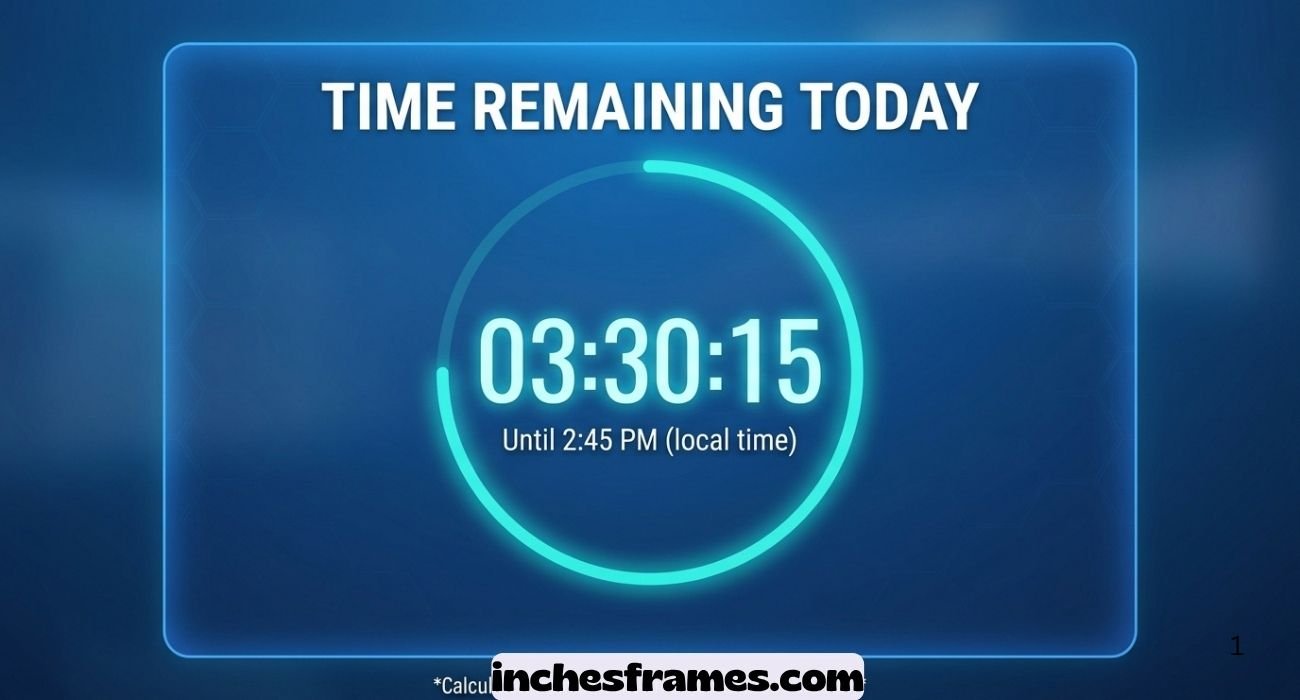
A live countdown can make this easier because it continuously updates as each minute and second passes. This is especially useful when you are close to 2:45 PM and need to know the remaining time without doing repeated calculations.
How Many Minutes Are Left Until 2:45 PM?
Converting the countdown into minutes can make the remaining time easier to understand. For example, 1 hour and 45 minutes equals 105 minutes, while 30 minutes before 2:45 PM means exactly 30 minutes remain.
Minute-based calculations are particularly helpful for short deadlines, meetings, study sessions, and appointments. If it is already 2:30 PM, for instance, you know immediately that only 15 minutes remain until the target time.
How Accurate Is a 2:45 PM Countdown Timer?
A countdown timer can provide a precise representation of the remaining time when it is based on an accurate device clock. The timer continuously measures the interval between the current moment and the target time, displaying the result in hours, minutes, and sometimes seconds.
Small differences can occur between devices, especially if their clocks are not synchronized. For important schedules, it is useful to make sure your device has the correct date, time, and time-zone settings before relying on a countdown.
What Is the Difference Between 2:45 AM and 2:45 PM?
2:45 AM and 2:45 PM are twelve hours apart, so confusing them can produce a completely different countdown. In the 24-hour clock, 2:45 AM is 02:45, while 2:45 PM is 14:45.
This distinction matters when setting alarms, calendar events, appointments, or online meetings. Always check the AM or PM designation when calculating how long until 2:45 PM, particularly when the target time is being entered into a digital scheduling tool.
How to Plan Your Day Around a 2:45 PM Deadline
A fixed target such as 2:45 PM can serve as a useful point for organizing the rest of the day. Instead of treating the available time as an open-ended period, you can estimate what can realistically be completed before the target arrives.
For example, if you have two hours until 2:45 PM, you can divide that period between an important task and a final review. As the countdown gets shorter, shift your focus toward finishing current work, preparing for the next activity, or leaving enough time to transition to whatever is scheduled at 2:45 PM.
Quick Reference: Time Remaining Until 2:45 PM
The following table provides a simple reference for common times before the target.
| Current Time | Remaining Until 2:45 PM |
|---|---|
| 7:00 AM | 7 hours 45 minutes |
| 8:00 AM | 6 hours 45 minutes |
| 9:00 AM | 5 hours 45 minutes |
| 10:00 AM | 4 hours 45 minutes |
| 11:00 AM | 3 hours 45 minutes |
| 12:00 PM | 2 hours 45 minutes |
| 1:00 PM | 1 hour 45 minutes |
| 1:15 PM | 1 hour 30 minutes |
| 1:30 PM | 1 hour 15 minutes |
| 1:45 PM | 1 hour |
| 2:00 PM | 45 minutes |
| 2:15 PM | 30 minutes |
| 2:30 PM | 15 minutes |
| 2:40 PM | 5 minutes |
| 2:44 PM | 1 minute |
| 2:45 PM | 0 minutes |
For times after 2:45 PM, use tomorrow’s 2:45 PM if you are asking about the next occurrence.
Frequently Asked Questions About How Long Until 2:45 PM
How many hours until 2:45 PM?
The number of hours depends on the current time. For example, at 12:00 PM, there are 2 hours and 45 minutes until 2:45 PM. At 1:00 PM, there are 1 hour and 45 minutes.
How many minutes until 2:45 PM?
Subtract the current time from 2:45 PM. For example, at 2:20 PM, there are 25 minutes remaining. At 2:40 PM, there are five minutes.
What time is 2:45 PM in 24-hour time?
2:45 PM is 14:45 in 24-hour time. It may also be written as 1445 in systems that omit the colon.
What is 2:45 PM in military time?
The equivalent is 1445. The 24-hour format avoids the AM/PM distinction.
How long is it from 12 PM to 2:45 PM?
It is 2 hours and 45 minutes, or 165 minutes.
How long is it from 1 PM to 2:45 PM?
It is 1 hour and 45 minutes, or 105 minutes.
How long is it from 2 PM to 2:45 PM?
It is 45 minutes.
How long is it from 2:30 PM to 2:45 PM?
It is 15 minutes.
What if it is already after 2:45 PM?
If you mean the next occurrence of 2:45 PM, the target is tomorrow. For example, at 4:00 PM, the next 2:45 PM is 22 hours and 45 minutes away.
Does the time zone affect how long until 2:45 PM?
Yes, when 2:45 PM refers to a particular location. If you mean 2:45 PM in your own location, use your local clock. If you mean 2:45 PM in another location, such as Asia/Karachi, you must account for the difference between the two time zones.
How many seconds are in 45 minutes?
There are 2,700 seconds in 45 minutes because 45 × 60 = 2,700.
Can I calculate the countdown without an app?
Yes. Subtract your current time from 2:45 PM. For more complicated calculations, converting both times into total minutes after midnight is a reliable method.
Conclusion: Make the Time Until 2:45 PM Work for You
The answer to how long until 2:45 PM depends on your current local time. The basic calculation is simple: compare the current time with 2:45 PM, or 14:45 in the 24-hour clock.
At 12:00 PM, 2 hours and 45 minutes remain. At 1:00 PM, 1 hour and 45 minutes remain. At 2:30 PM, only 15 minutes are left. Once 2:45 PM has passed, the next occurrence is tomorrow if you are using a daily countdown.
For everyday planning, a clock may be enough. When you need an exact countdown to 2:45 PM, a timer can automatically track the changing hours, minutes, and seconds. And when different locations are involved, always identify the relevant time zone before calculating the countdown.