What Time Was It 5 Hours Ago? Calculate the Exact Time
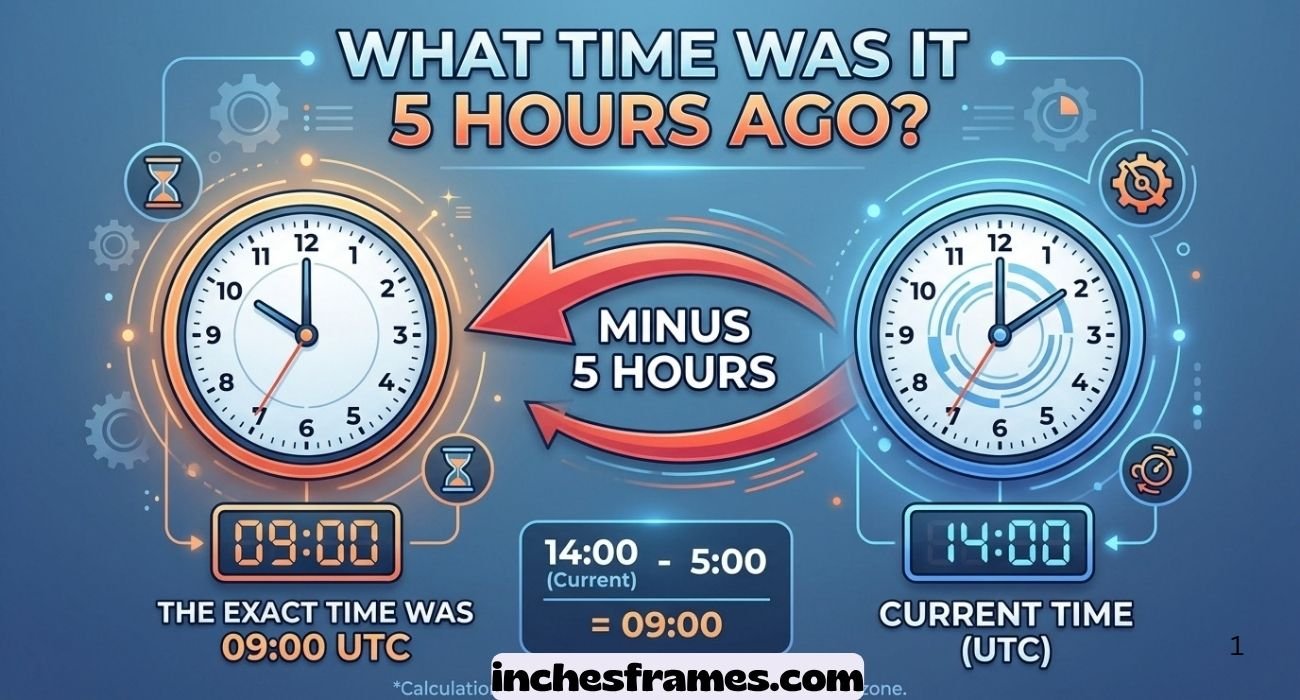
If you are asking, “What time was it 5 hours ago?”, the basic answer is simple: subtract 5 hours from the current time. For example, if it is 6:00 PM now, 5 hours ago it was 1:00 PM. If it is 3:00 AM, 5 hours ago was 10:00 PM on the previous day.
The calculation becomes slightly more interesting when you cross midnight, switch between AM and PM, compare different time zones, or work with a timestamp from another location.
The basic formula is:
Time 5 hours ago = Current time − 5 hours
This guide explains how to calculate five hours ago manually, use both the 12-hour and 24-hour clock, handle midnight and date changes, understand time-zone differences, and avoid common mistakes.
Understanding What Time Was It 5 Hours Ago
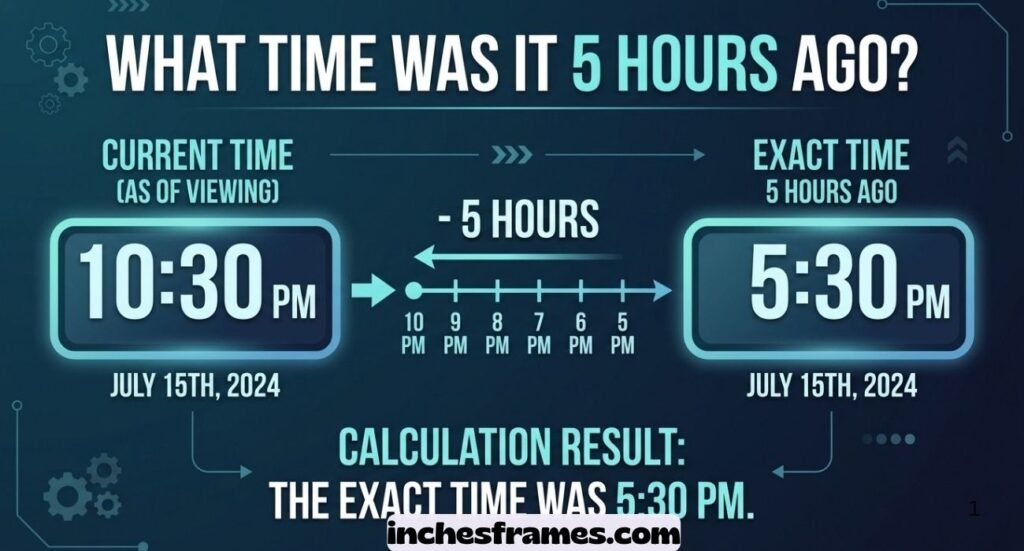
“What time was it 5 hours ago?” means you want to find the point in time that occurred exactly five hours before a given current time or reference time.
Because one hour contains 60 minutes, five hours equals:
5 hours = 300 minutes = 18,000 seconds
When you subtract exactly five whole hours, the minutes normally stay the same. Only the hour changes.
For example, if the current time is 9:25 AM:
9:25 AM − 5 hours = 4:25 AM
If the current time is 8:40 PM:
8:40 PM − 5 hours = 3:40 PM
The main complication occurs when moving backward past midnight. Suppose the current time is 2:15 AM. Going back five hours gives:
2:15 AM − 5 hours = 9:15 PM on the previous day
So the answer is not just a different clock reading. The date changes too.
This distinction is important when checking messages, work records, travel schedules, digital timestamps, or any other event where the day matters.
How Time Subtraction Actually Works
Calculating five hours ago is a form of time subtraction. You start with a known time and move backward by five one-hour intervals.
The simplest method is:
Current hour − 5 = Earlier hour
The minutes remain unchanged when you are subtracting exactly five hours.
For example:
7:35 PM − 5 hours = 2:35 PM
You can also think of the calculation as moving around a clock:
7:35 PM → 6:35 PM → 5:35 PM → 4:35 PM → 3:35 PM → 2:35 PM
The result is 2:35 PM.
The important exception is when the backward movement passes 12:00 AM. In that situation, you must also move the calendar date backward by one day.
For example:
3:35 AM − 5 hours = 10:35 PM the previous day
The minutes remain 35, but the date changes because the calculation crosses midnight.
A useful way to avoid mistakes is to separate the calculation into two questions:
- What was the clock time five hours earlier?
- Did moving backward five hours cross midnight?
If the answer to the second question is yes, the result belongs to the previous calendar day.
Why Reverse Time Calculation Matters in Everyday Life
Knowing how to calculate 5 hours ago from now is useful whenever you need to reconstruct when something happened.
You might see a timestamp and wonder when an earlier event occurred. You might be reviewing a work schedule, checking a travel record, looking at a message history, or trying to understand the order of several events.
For example, imagine that a notification was recorded at 7:20 PM and you need to know the time exactly five hours earlier. You simply calculate:
7:20 PM − 5 hours = 2:20 PM
The same approach works for almost any timestamp.
Reverse time calculations are also useful because they separate an exact mathematical interval from an approximate human description. Saying “that happened about five hours ago” is an estimate. Saying “that happened at 2:20 PM, exactly five hours before the 7:20 PM timestamp” is a precise calculation.
This is particularly helpful when working with hours and minutes, digital records, schedules, and events that span different parts of a day.
What Time Was It 5 Hours Ago Using the 12-Hour Clock
The 12-hour clock is widely used in everyday life in the United States. It divides a 24-hour day into two periods:
- AM: midnight through before noon
- PM: noon through before midnight
When calculating five hours ago, subtract five from the hour while keeping the minutes unchanged.
| Current Time | 5 Hours Ago |
|---|---|
| 8:00 AM | 3:00 AM |
| 10:30 AM | 5:30 AM |
| 12:15 PM | 7:15 AM |
| 2:45 PM | 9:45 AM |
| 6:20 PM | 1:20 PM |
| 9:50 PM | 4:50 PM |
| 11:10 PM | 6:10 PM |
The transition between AM and PM is one of the most common places people make mistakes.
For example:
1:00 PM − 5 hours = 8:00 AM
The result is AM because moving backward five hours crosses noon.
Likewise:
4:00 AM − 5 hours = 11:00 PM the previous day
Here, the calculation crosses midnight, so both the AM/PM designation and the date change.
What about 12:00 AM and 12:00 PM?
These two times can cause confusion.
12:00 AM = midnight
12:00 PM = noon
Therefore:
12:00 PM − 5 hours = 7:00 AM
But:
12:00 AM − 5 hours = 7:00 PM on the previous day
Remembering that 12:00 AM represents the beginning of a new day makes these calculations much easier.
What Time Was It 5 Hours Ago Using the 24-Hour Clock
The 24-hour clock represents the entire day using numbers from 00:00 through 23:59. It removes the need for AM and PM.
Some common conversions are:
| 12-Hour Time | 24-Hour Time |
|---|---|
| 12:00 AM | 00:00 |
| 6:00 AM | 06:00 |
| 12:00 PM | 12:00 |
| 3:00 PM | 15:00 |
| 6:00 PM | 18:00 |
| 9:00 PM | 21:00 |
| 11:00 PM | 23:00 |
With this format, subtracting five hours is straightforward.
For example:
18:30 − 5 hours = 13:30
So 5 hours before 18:30 was 13:30, or 1:30 PM.
Another example:
04:15 − 5 hours
Because 4 − 5 produces a negative hour, the calculation crosses midnight. Add 24 hours before subtracting:
04:15 + 24:00 = 28:15
Then:
28:15 − 5:00 = 23:15
So the answer is 23:15 on the previous day, or 11:15 PM the previous day.
The 24-hour system can be especially convenient for schedules, transportation records, computer systems, and other digital clocks because AM and PM ambiguity disappears.
Crossing Midnight: The Most Common Mistake
Crossing midnight is probably the most important detail to watch when calculating what time was five hours ago.
Suppose the current time is 2:00 AM. Counting backward gives:
2:00 AM → 1:00 AM → 12:00 AM → 11:00 PM → 10:00 PM → 9:00 PM
Therefore:
2:00 AM − 5 hours = 9:00 PM the previous day
The answer is 9:00 PM, but it is not 9:00 PM on the same date.
Consider another example:
1:30 AM − 5 hours = 8:30 PM the previous day
The five-hour interval moves from the early morning into the previous evening.
A simple rule helps:
If subtracting five hours takes you before 12:00 AM, the result belongs to the previous calendar day.
The same principle applies regardless of whether you use a 12-hour or 24-hour clock.
Midnight matters because clock time and calendar date are connected. A clock can show 11:00 PM, but you also need to know which date that 11:00 PM belongs to.
Manual Time Arithmetic Without a Calculator
For most five-hour calculations, you do not need a time calculator. You can work backward mentally.
Start with the current hour and minutes. Keep the minutes exactly as they are, then move the hour backward five positions.
For example:
10:45 PM − 5 hours = 5:45 PM
No change to the minutes is necessary.
If the subtraction crosses midnight, simply move to the previous day.
Example 1
Suppose the current time is 6:30 PM.
Move backward five hours:
6:30 PM → 5:30 PM → 4:30 PM → 3:30 PM → 2:30 PM → 1:30 PM
Therefore:
6:30 PM − 5 hours = 1:30 PM
The calculation stays on the same day.
Example 2
Suppose the current time is 2:15 PM.
Move backward:
2:15 PM → 1:15 PM → 12:15 PM → 11:15 AM → 10:15 AM → 9:15 AM
Therefore:
2:15 PM − 5 hours = 9:15 AM
Notice that the calculation crosses from PM to AM when it passes noon.
Example 3
Suppose the current time is 3:45 AM.
Moving backward five hours crosses midnight:
3:45 AM → 2:45 AM → 1:45 AM → 12:45 AM → 11:45 PM → 10:45 PM
Therefore:
3:45 AM − 5 hours = 10:45 PM on the previous day
This example demonstrates why checking the date is just as important as checking the clock.
See Also : How Long Until 2:15? Simple Time Calculation Guide
Using Online Time Calculators
An online time calculator can perform the same subtraction automatically. It becomes especially useful when the calculation involves more than one variable, such as a particular date, location, or time zone.
For a simple question such as “What time was it five hours ago?”, manual arithmetic is usually enough. But an online tool can reduce mistakes when you are working with a detailed timestamp.
A typical time calculator may allow you to enter a starting date and time, choose a time zone, and specify how many hours or minutes to add or subtract.
For example, you could enter:
Starting time: 2:15 AM
Adjustment: −5 hours
The result would be:
9:15 PM on the previous day
A time calculator is particularly useful when you need to calculate several intervals or work with dates as well as times.
The key is to understand what the calculator is calculating. A basic calculator may simply subtract hours from a clock reading, while a time-zone-aware tool may account for the local date and time associated with a particular location.
Time Zones Make Everything More Interesting
The phrase “five hours ago” is always relative to a particular reference time. If two people are in different locations, their local time may be different at the same moment.
For example, imagine one person is looking at a clock showing 6:00 PM while another person in a different U.S. time zone sees 3:00 PM. Five hours before those local readings would be:
6:00 PM − 5 hours = 1:00 PM
and
3:00 PM − 5 hours = 10:00 AM
Both calculations are correct for their respective local clock readings.
The United States has multiple major time zones, including Eastern, Central, Mountain, Pacific, Alaska, and Hawaii-Aleutian time. A timestamp should therefore be interpreted together with its location or time-zone information when precision matters.
This becomes especially important for flights, remote work, online meetings, live events, and international communication.
There is also a difference between elapsed time and a displayed local clock time. Five hours of elapsed time means exactly 300 minutes. A local clock reading can be affected by calendar and time-zone rules, so comparing timestamps from different locations requires more information than simply subtracting the numbers shown on two clocks.
Real-Life Examples of Five-Hour Calculations
The five-hour interval appears in many practical situations. The arithmetic itself does not change; what changes is the context surrounding the timestamp.
Medication Timing
Someone reviewing a medication schedule may need to determine when a previous recorded event occurred. For example, if a timestamp says 8:00 PM and the relevant interval is five hours earlier:
8:00 PM − 5 hours = 3:00 PM
The calculation tells you the earlier clock time.
However, a time calculation should not be used by itself to decide when to take a medication. Medication schedules should be based on the product instructions or guidance from an appropriate healthcare professional. The mathematical calculation simply establishes the relationship between two times.
Flight Timing
Travel often involves timestamps, scheduled departure times, arrival times, and multiple time zones.
Suppose a travel record shows a local timestamp of 11:30 PM. Five hours earlier in that same time reference is:
11:30 PM − 5 hours = 6:30 PM
For flights, however, you must pay attention to which location the timestamp represents. A departure time may be shown in the departure airport’s local time, while an arrival time may use the arrival airport’s local time.
That means “five hours ago” and “five hours earlier on the flight schedule” are not always interchangeable without knowing the applicable time zone.
Shift Calculation
Work schedules provide another straightforward example.
If a shift record shows an event at 5:00 PM and you need to identify the time five hours earlier:
5:00 PM − 5 hours = 12:00 PM
If the timestamp instead shows 3:00 AM:
3:00 AM − 5 hours = 10:00 PM the previous day
The second calculation matters because the shift may span two calendar dates.
Memory Reconstruction
Suppose you remember receiving a message at 9:15 PM and want to determine when something happened five hours before that timestamp.
9:15 PM − 5 hours = 4:15 PM
The arithmetic gives you an exact five-hour offset from the known timestamp. Your memory of the event itself may still be approximate, so it is useful to distinguish the mathematical calculation from an uncertain recollection.
Gaming
Players may need to work backward from timestamps for game sessions, server events, tournament schedules, or online activity.
If an event was recorded at 1:00 AM, five hours earlier was:
8:00 PM on the previous day
Online games can introduce another layer because a game’s server may use a different clock or time zone from the player’s local clock. When checking an event, use the time reference attached to the game’s timestamp rather than automatically assuming it represents local time.
Human Perception Versus Digital Precision
People do not always perceive elapsed time with exact accuracy. Someone might say an event happened “five hours ago” when the actual interval was 4 hours and 50 minutes or 5 hours and 10 minutes.
That is different from a timestamp-based calculation.
If a digital record says an event occurred at 2:00 PM and the reference time is 7:00 PM, the interval is exactly five hours.
7:00 PM − 2:00 PM = 5 hours
But if someone simply remembers that the event happened around five hours ago, the statement may be an estimate.
This distinction matters when precision is important. A digital timestamp can identify a recorded clock time, while human memory may provide only an approximate time.
It is also useful to distinguish three related measurements:
5 hours = 300 minutes
5 hours = 18,000 seconds
5 hours = one five-hour elapsed interval
These describe the same duration, expressed at different levels of precision.
Tips for Accurate Reverse Time Calculation
The easiest way to avoid mistakes is to use the same process every time.
- Start with the exact reference time.
- Keep the minutes unchanged if you are subtracting exactly five whole hours.
- Move the hour backward by five.
- Check whether the calculation changes AM to PM or PM to AM.
- Check whether you crossed midnight.
- If midnight was crossed, move the date back by one day.
- If another location is involved, identify the correct time zone before comparing timestamps.
- Use a calculator when the calculation involves multiple dates, locations, or time conversions.
Consider the difference between these two examples:
8:30 PM − 5 hours = 3:30 PM
No date change occurs.
But:
2:30 AM − 5 hours = 9:30 PM the previous day
The clock arithmetic is simple in both cases. The second calculation requires an additional date adjustment.
Another useful habit is to avoid treating 12:00 AM as “12 hours after midnight.” Instead, remember that 12:00 AM is midnight and 12:00 PM is noon. This removes one of the most common sources of confusion in the 12-hour clock.
How to Calculate 5 Hours Ago From Any Starting Time
The easiest way to find a time five hours earlier is to treat the starting time as your reference point and move backward one hour at a time. For example, if the starting time is 7:25 PM, subtracting five hours gives 2:25 PM. The minutes stay the same because you are subtracting complete hours.
When the calculation reaches midnight, remember to move to the previous day. For example, 3:10 AM minus five hours is 10:10 PM on the previous day. This simple method works with both the 12-hour and 24-hour clock.
See Also : How Long Until 2:45 PM? Calculate the Time Remaining Today
What Time Was It 5 Hours Ago With Minutes and Seconds?
When the starting time includes minutes and seconds, subtracting exactly five hours normally leaves both values unchanged. For example, 9:35:20 PM minus five hours is 4:35:20 PM. Only the hour changes because the interval being subtracted contains no additional minutes or seconds.
This can be useful when checking precise digital timestamps, activity logs, or recorded events. If you need to subtract five hours and additional minutes or seconds, calculate each part separately and make sure to account for any borrowing across an hour or midnight.
How 5 Hours Ago Changes Across a Full Day
A five-hour interval can occur entirely within the same calendar day or extend into the previous day. The deciding factor is the starting time. If the current time is 6:00 AM, five hours earlier is 1:00 AM on the same day. If the current time is 3:00 AM, five hours earlier is 10:00 PM on the previous day.
This is why knowing only the clock time is sometimes not enough. When reviewing a timestamp, always consider the date as well. A result such as 11:30 PM could refer to the previous evening rather than the same calendar day.
Five Hours Ago Versus Five Hours From Now
“Five hours ago” and “five hours from now” describe opposite directions on the timeline. Five hours ago means moving backward from the reference time, while five hours from now means moving forward. If the reference time is 4:00 PM, five hours ago is 11:00 AM, while five hours from now is 9:00 PM.
Understanding this difference is especially useful when working with schedules and countdown timers. A past event requires subtraction, while a future event requires addition. In both cases, crossing midnight may change the calendar date.
When Should You Double-Check a Five-Hour Time Calculation?
A simple five-hour calculation usually takes only a few seconds, but some situations deserve an extra check. Pay particular attention when the starting time is between midnight and 5:00 AM, when the date will change, or when a timestamp comes from another time zone.
It is also worth checking the result when the time is connected to a scheduled event, travel record, work log, or other precise timestamp. A quick review using a time calculator or 24-hour clock can help confirm that the hour, AM/PM designation, and date are all correct.
Quick Reference for What Time Was It 5 Hours Ago
The table below provides common examples of five-hour reverse calculations.
| Current Time | Five Hours Earlier |
|---|---|
| 1:00 AM | 8:00 PM previous day |
| 2:00 AM | 9:00 PM previous day |
| 3:00 AM | 10:00 PM previous day |
| 4:00 AM | 11:00 PM previous day |
| 5:00 AM | 12:00 AM |
| 6:00 AM | 1:00 AM |
| 7:00 AM | 2:00 AM |
| 8:00 AM | 3:00 AM |
| 9:00 AM | 4:00 AM |
| 10:00 AM | 5:00 AM |
| 11:00 AM | 6:00 AM |
| 12:00 PM | 7:00 AM |
| 1:00 PM | 8:00 AM |
| 2:00 PM | 9:00 AM |
| 3:00 PM | 10:00 AM |
| 4:00 PM | 11:00 AM |
| 5:00 PM | 12:00 PM |
| 6:00 PM | 1:00 PM |
| 7:00 PM | 2:00 PM |
| 8:00 PM | 3:00 PM |
| 9:00 PM | 4:00 PM |
| 10:00 PM | 5:00 PM |
| 11:00 PM | 6:00 PM |
| 12:00 AM | 7:00 PM previous day |
The minutes follow the same pattern. For example, if the current time is 8:37 PM, five hours earlier is 3:37 PM. If it is 2:37 AM, five hours earlier is 9:37 PM on the previous day.
Frequently Asked Questions
What time was it 5 hours ago from now?
It depends on the current time. To calculate it, subtract five hours from the current local time. For example, if it is 6:00 PM, five hours ago was 1:00 PM.
How do I calculate 5 hours ago manually?
Subtract five from the current hour while keeping the minutes unchanged. Then check whether the calculation crosses noon or midnight. If it crosses midnight, the answer belongs to the previous calendar day.
What was 5 hours ago if it is 2 AM?
If it is 2:00 AM, five hours ago was 9:00 PM on the previous day. The calculation crosses midnight, so the date changes.
What was 5 hours ago if it is 12 PM?
If it is 12:00 PM, five hours ago was 7:00 AM on the same day.
Does 5 hours ago always mean the same time on the previous day?
No. Five hours ago can be on the same day or the previous day. It moves to the previous day only when subtracting five hours crosses midnight.
How many minutes ago is 5 hours?
Five hours equals 300 minutes. Therefore, an event exactly five hours earlier occurred 300 minutes before the reference time.
Can the time zone affect what time it was 5 hours ago?
Yes, when the reference time comes from a particular location or when you are comparing timestamps from different places. Five elapsed hours is always 300 minutes, but the corresponding local clock readings can differ by time zone.
Is 5 hours ago the same as five hours before now?
Yes, when “now” is the reference point. Both phrases describe a point exactly five hours before the current time.
What is 5 hours ago in 24-hour time?
You subtract five from the current 24-hour clock value. For example, 21:00 minus five hours is 16:00. If the calculation goes below 00:00, move to the previous day.
Do minutes change when you subtract 5 hours?
Not when you are subtracting exactly five whole hours. For example, 7:42 PM minus five hours is 2:42 PM. The minutes remain 42.
Conclusion
Calculating what time was it 5 hours ago is usually as simple as subtracting five hours from the reference time. If it is 8:00 PM, the answer is 3:00 PM. If it is 2:00 AM, the answer is 9:00 PM on the previous day.
The key is to check more than just the hour. Pay attention to the AM and PM, determine whether the calculation crosses midnight, and adjust the date when necessary. If different locations are involved, also identify the relevant time zone.
For a straightforward timestamp, mental arithmetic is usually enough. For complicated schedules involving locations, dates, or multiple timestamps, an online time calculator can provide an additional check. Once you understand the basic rule—current time minus five hours—you can quickly work backward from almost any clock time.