How Long Until 2:45 PM? Simple Time Guide, Examples & FAQs
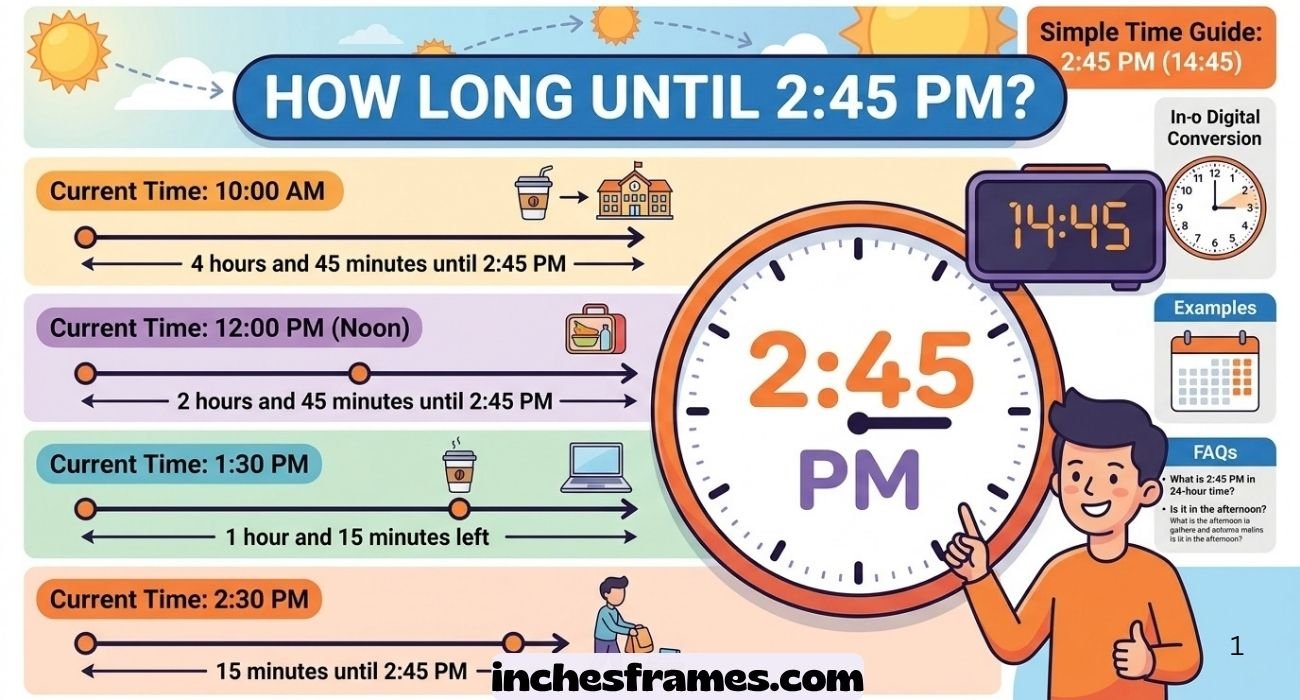
If you are asking, “How long until 2:45 PM?”, the exact answer depends on the current time. For example, if it is 1:45 PM, there is exactly 1 hour until 2:45 PM. If it is 2:15 PM, there are 30 minutes left. If it is already 3:00 PM, today’s 2:45 PM has passed.
The easiest way to find the time until 2:45 PM is to compare the current local time with the target time. This guide explains how to calculate the difference in hours, minutes, and seconds, how to handle AM and PM, what happens when 2:45 PM has already passed, and how time zones and date changes can affect a countdown.
1. Meaning / Definition
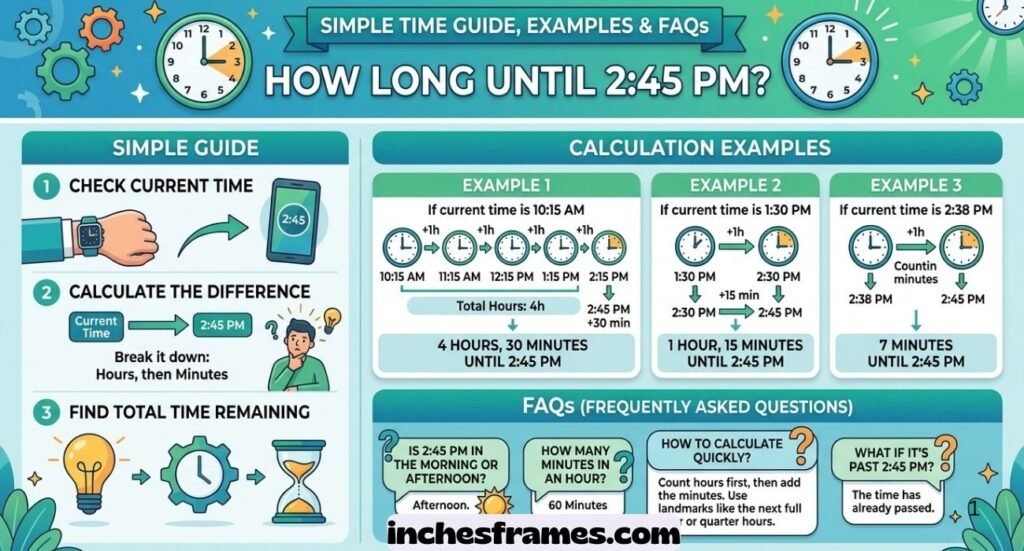
The phrase “how long until 2:45 PM” means asking for the amount of time remaining between the current time and 2:45 PM.
The target time, 2:45 PM, is in the afternoon. On a standard 12-hour clock, it occurs 45 minutes after 2:00 PM. In the 24-hour clock, 2:45 PM is written as 14:45.
There is no single answer to “how long until 2:45 PM?” because the answer changes continuously as the clock moves forward.
Quick Answer
The exact countdown to 2:45 PM depends on your current local time.
For example:
| Current Time | Time Until 2:45 PM |
|---|---|
| 12:00 PM | 2 hours 45 minutes |
| 12:30 PM | 2 hours 15 minutes |
| 1:00 PM | 1 hour 45 minutes |
| 1:15 PM | 1 hour 30 minutes |
| 1:30 PM | 1 hour 15 minutes |
| 1:45 PM | 1 hour |
| 2:00 PM | 45 minutes |
| 2:15 PM | 30 minutes |
| 2:30 PM | 15 minutes |
| 2:40 PM | 5 minutes |
| 2:45 PM | 0 minutes |
So, if your question is how long until 2:45 PM today, first check your current clock. Then calculate the difference between that time and 2:45 PM.
If it is already later than 2:45 PM, you need to decide whether you mean the 2:45 PM that has already passed or the next 2:45 PM, which will normally be the following day.
2. Meaning in Simple Words
Think of 2:45 PM as a destination on a clock.
Your current time is where you are now, and 2:45 PM is where you want to arrive. The time difference between those two points tells you how long you have to wait.
For instance, suppose the current time is 1:20 PM. From 1:20 PM to 2:20 PM is 1 hour. From 2:20 PM to 2:45 PM is another 25 minutes. Therefore:
1 hour + 25 minutes = 1 hour 25 minutes
That is the amount of time until 2:45 PM.
The same idea works whether you need to calculate hours, minutes, or seconds.
Easy Calculation Method
There are two simple ways to calculate the time until 2:45 PM.
The first is ordinary clock subtraction. Look at the current hour and minutes, then determine how much time remains before 2:45 PM.
For example:
Current time: 1:35 PM
Target time: 2:45 PM
From 1:35 PM to 2:35 PM = 1 hour.
From 2:35 PM to 2:45 PM = 10 minutes.
Therefore, the answer is 1 hour 10 minutes.
The second method is to convert both times into minutes after noon. This can make calculations easier when the minute values are less convenient.
2:45 PM is 165 minutes after noon:
2 × 60 + 45 = 165 minutes
If the current time is 1:35 PM:
1 × 60 + 35 = 95 minutes
Now subtract:
165 − 95 = 70 minutes
And 70 minutes equals 1 hour 10 minutes.
This approach is particularly useful when building a time calculator or checking a more complicated countdown timer.
Remember the basic relationships:
- 1 hour = 60 minutes
- 1 minute = 60 seconds
- 1 hour = 3,600 seconds
- 90 minutes = 1 hour 30 minutes
If you need the answer down to the second, use the same principle but include the current seconds in the calculation.
3. Real-Life Examples
The question how long until 2:45 PM can come up in many ordinary situations. A scheduled activity may start at 2:45 PM, a deadline may arrive at that time, or you may simply want to know how much of the afternoon remains before a particular event.
Example 1: Lunch Break
Imagine your lunch schedule ends with a planned activity at 2:45 PM, and the current time is 1:15 PM.
From 1:15 PM to 2:15 PM is 1 hour. From 2:15 PM to 2:45 PM is 30 minutes.
Therefore, there are 1 hour 30 minutes until 2:45 PM.
You could use that period for lunch, preparation, errands, or travel, depending on your schedule.
Example 2: School Class
Suppose a class begins at 2:45 PM and the current time is 1:50 PM.
From 1:50 PM to 2:45 PM is:
55 minutes
A student could use those 55 minutes to finish a task, gather materials, travel to class, or review notes.
This is also a good example of why simply looking at the hour can be misleading. The difference is less than 1 hour even though the clock changes from the 1 o’clock hour to the 2 o’clock hour.
Example 3: Work Meeting
Suppose you have a work meeting scheduled for 2:45 PM and your clock shows 2:05 PM.
The calculation is:
2:45 − 2:05 = 40 minutes
So there are 40 minutes until 2:45 PM.
That may be enough time to finish another task, review meeting notes, prepare documents, or join an online meeting a few minutes early.
Example 4: Appointment
Imagine an appointment starts at 2:45 PM and it is currently 1:30 PM.
The difference is:
1 hour 15 minutes
However, the countdown itself does not tell you when you should leave home. If you need 25 minutes to travel and 10 minutes to check in, those activities should be deducted from the available time.
This distinction matters: time until an appointment and time available before leaving for an appointment are not necessarily the same thing.
Example 5: Travel Planning
Suppose you are planning around a 2:45 PM departure and it is currently 12:45 PM.
There are 2 hours until 2:45 PM.
That does not necessarily mean you have two hours before you need to leave. Traffic, parking, security procedures, boarding times, transfers, and other requirements may mean you need to start traveling earlier.
For travel, always distinguish between the scheduled event time and your personal arrival or departure time.
Example 6: Online Event
Suppose a virtual class or webinar begins at 2:45 PM and the current time is 2:20 PM.
There are:
This gives you time to open the meeting link, check your internet connection, find the required materials, and be ready before the event begins.
For online events, also check the stated time zone. An event advertised as 2:45 PM Eastern Time does not occur at the same moment as an event advertised as 2:45 PM Pacific Time.
Example 7: Homework Deadline
Suppose an assignment is due at 2:45 PM and the current time is 1:55 PM.
The remaining time is:
50 minutes
A practical schedule might divide those 50 minutes between finishing the assignment, checking the work, and submitting it.
A countdown is useful here because the available time decreases continuously. At 2:15 PM, for example, only 30 minutes would remain.
See Also : How Long Until 2:30 PM? Calculate the Exact Time Remaining Today
Synonyms and Related Terms
People do not always phrase a time question in exactly the same way. Someone searching for how long until 2:45 PM might instead search for “how much time until 2:45 PM,” “how many minutes until 2:45 PM,” or “2:45 PM countdown.”
These phrases generally describe the same basic task: finding the duration between the current time and a target time.
Related Time Keywords
Common variations include time until 2:45 PM, countdown to 2:45 PM, 2:45 PM countdown, time remaining until 2:45 PM, and how long before 2:45 PM.
There are also more specific questions. “How many hours until 2:45 PM?” focuses on hours, while “how many minutes until 2:45 PM?” asks for the total duration in minutes.
For example, if it is 1:15 PM:
- Time remaining = 1 hour 30 minutes
- Total minutes remaining = 90 minutes
- Total seconds remaining = 5,400 seconds
The phrase “what time is 2:45 PM?” is slightly different. It asks about the clock time itself rather than the duration remaining until that time.
When to Use
A countdown to 2:45 PM is useful whenever a specific activity, deadline, or event is tied to that time.
For Appointments
If an appointment is scheduled for 2:45 PM, calculating the remaining time can help you organize preparation and transportation.
The useful calculation is not only “how long until 2:45 PM?” but also “how much preparation and travel time do I need before 2:45 PM?”
For School
Students can use a 2:45 PM countdown for classes, activities, study sessions, or assignment deadlines.
Knowing that 45 minutes remain is more useful than simply knowing that the event is “later in the afternoon,” because it gives you a measurable planning window.
For Work
A 2:45 PM target can represent a meeting, phone call, project deadline, shift change, or scheduled break.
A countdown timer can be especially useful when you are working on another task and want a visible reminder of how much time remains.
For Travel
A target time such as 2:45 PM might represent a pickup, departure, connection, reservation, or scheduled arrival.
However, the clock countdown should be used alongside the actual itinerary. A 2:45 PM departure time may require you to arrive considerably earlier.
For Cooking
A target time can help you plan when food should be prepared or served.
For example, if dinner preparation needs to be completed by 2:45 PM, knowing the remaining time can help you decide when to start each cooking step.
For Exercise
You might have a workout, fitness class, walk, or training session scheduled for 2:45 PM.
If it is 2:10 PM, there are 35 minutes remaining. You can use that information to decide when to change clothes, gather equipment, or travel to the location.
For Online Meetings
A 2:45 PM virtual meeting can be managed with a simple countdown.
If it is 2:30 PM, you have 15 minutes. That can be enough time to open the meeting platform and prepare your notes.
The key is to verify the event’s local time and time zone before relying on the countdown.
For Daily Planning
A fixed time such as 2:45 PM can serve as a useful checkpoint in a daily schedule.
Instead of viewing the afternoon as one large block, you can divide it into smaller periods. For example, if it is 12:45 PM, you have two hours until 2:45 PM. That can be divided into focused work, a break, and preparation for the next activity.
When NOT to Use
A simple time-until calculation works well when the current time and target time are clear. Some situations require more information.
When You Do Not Know the Current Time
You cannot calculate an exact countdown without knowing the starting time.
For example, “How long until 2:45 PM?” cannot have one fixed answer because the result could be 3 hours, 30 minutes, 5 minutes, or zero depending on when the question is asked.
Check your digital clock, phone, computer, or another reliable clock before calculating.
When the Time Zone Is Different
A target time without a time zone can be ambiguous when people are in different locations.
For example, 2:45 PM Eastern Time and 2:45 PM Pacific Time occur three hours apart under the standard U.S. time-zone relationship.
If someone tells you an online meeting begins at 2:45 PM, check whether that means your local time or the organizer’s time.
When 2:45 PM Has Already Passed
Suppose the current time is 4:00 PM.
Today’s 2:45 PM has already occurred. You should not calculate a negative countdown and assume that is the useful answer.
If the question means the next occurrence of 2:45 PM, the target is normally 2:45 PM on the following day.
From 4:00 PM today to 2:45 PM tomorrow is 22 hours 45 minutes.
When the Date Is Important
A clock time alone does not always identify an event.
“2:45 PM” could refer to today, tomorrow, a future date, or a recurring daily event.
For an appointment, deadline, flight, reservation, or other scheduled event, the date and time should be considered together.
When Daylight Saving Time Matters
Daylight Saving Time can affect elapsed-time calculations when an interval crosses a clock change.
For example, the United States changes clocks for Daylight Saving Time in most states, although some locations follow different rules. If you are calculating a long interval that crosses a clock change, simply subtracting the displayed clock readings may not give the actual elapsed duration.
For an ordinary same-day calculation, this issue generally does not arise. It becomes more relevant when calculating across dates or scheduling events far in advance.
Common Mistakes
Most mistakes in a 2:45 PM countdown are simple clock-reading or subtraction errors.
Mistake 1: Forgetting AM and PM
2:45 AM and 2:45 PM are 12 hours apart.
If an event is scheduled for 2:45 PM and you accidentally treat it as 2:45 AM, the resulting calculation will be completely different.
Always check the AM/PM designation when using a 12-hour clock.
Mistake 2: Subtracting the Hours but Ignoring Minutes
Suppose the current time is 1:30 PM.
It may be tempting to say that 2:45 PM is “one hour away” because the hour changes from 1 to 2.
That is incorrect.
From 1:30 PM to 2:30 PM is 1 hour, and from 2:30 PM to 2:45 PM is another 15 minutes.
The correct answer is 1 hour 15 minutes.
Mistake 3: Forgetting the Next Day
If it is 5:00 PM, today’s 2:45 PM has already passed.
If you mean the next 2:45 PM, the target is tomorrow. From 5:00 PM today to midnight is 7 hours, and from midnight to 2:45 PM tomorrow is 14 hours 45 minutes.
Therefore:
7 hours + 14 hours 45 minutes = 21 hours 45 minutes
The date change is essential to getting the calculation right.
Mistake 4: Using the Wrong Time Zone
A time such as 2:45 PM only describes a clock reading unless its time zone is known.
This matters particularly for remote work, virtual events, travel, and communication between people in different parts of the country.
When a scheduled event is involved, verify the time zone before starting a countdown.
Mistake 5: Rounding Too Early
If 1 hour 35 minutes remain, saying “about 2 hours” may be acceptable for casual planning but can cause problems when precision matters.
For an appointment, deadline, departure, or meeting, keep the exact value until you know how much precision you need.
Mistake 6: Confusing 24-Hour and 12-Hour Time
The 12-hour clock uses AM and PM, while the 24-hour clock represents the afternoon using numbers from 13 through 23.
Therefore:
2:45 PM = 14:45
But:
2:45 AM = 02:45
Understanding this conversion is useful when reading travel schedules, technical systems, international timetables, or other displays that use 24-hour time.
Mistake 7: Forgetting That Time Changes
The answer to “how long until 2:45 PM?” is not permanent.
If it is 1:00 PM, there are 1 hour 45 minutes remaining.
Thirty minutes later, at 1:30 PM, there are only 1 hour 15 minutes remaining.
A further hour later, at 2:30 PM, only 15 minutes remain.
For this reason, a live countdown is more useful than a calculation that was made long before the event.
See Also : How Long Until 3:15 PM? Calculate the Exact Time Remaining Today
Comparison with Similar Terms
Understanding related time formats makes it easier to interpret schedules and calculate durations correctly.
12-Hour vs. 24-Hour Format
The 12-hour format divides the day into two 12-hour periods: AM and PM. This is the format commonly used for everyday clock times in the United States.
The 24-hour format runs continuously from 00:00 through 23:59.
| 12-Hour Time | 24-Hour Time | Meaning |
|---|---|---|
| 12:00 PM | 12:00 | Noon |
| 1:00 PM | 13:00 | Afternoon |
| 2:00 PM | 14:00 | Afternoon |
| 2:45 PM | 14:45 | Target time |
| 3:00 PM | 15:00 | Afternoon |
| 11:59 PM | 23:59 | Late night |
| 12:00 AM | 00:00 | Midnight |
One common source of confusion is midnight and noon. 12:00 PM is noon, while 12:00 AM is midnight.
For the target in this article, there is no ambiguity once the PM designation is included: 2:45 PM is 14:45.
Example Countdown Table
The following table provides a quick reference for the time until 2:45 PM at several starting times:
| Current Time | Remaining Time |
|---|---|
| 12:00 PM | 2 hours 45 minutes |
| 12:15 PM | 2 hours 30 minutes |
| 12:30 PM | 2 hours 15 minutes |
| 12:45 PM | 2 hours |
| 1:00 PM | 1 hour 45 minutes |
| 1:15 PM | 1 hour 30 minutes |
| 1:30 PM | 1 hour 15 minutes |
| 1:45 PM | 1 hour |
| 2:00 PM | 45 minutes |
| 2:15 PM | 30 minutes |
| 2:30 PM | 15 minutes |
| 2:40 PM | 5 minutes |
| 2:45 PM | 0 minutes |
| 3:00 PM | Today’s target has passed |
This table is useful for a quick estimate, but it cannot replace a live clock because every minute changes the result.
How to Plan Your Time Before 2:45 PM
Knowing how long until 2:45 PM can make it easier to organize tasks into the time you have available. If you have 90 minutes left, for example, you can divide that period between work, preparation, travel, or a short break instead of treating the entire period as one block.
The closer you get to 2:45 PM, the more useful an exact countdown becomes. A plan that works when you have two hours remaining may need to change when only 30 minutes are left, so checking the current time regularly can help you stay on schedule.
How to Convert the Time Until 2:45 PM Into Minutes
Converting the remaining time into minutes can make a countdown easier to understand and compare. For example, 1 hour 30 minutes until 2:45 PM is the same as 90 minutes, while 45 minutes means less than one hour remains.
To convert hours into minutes, multiply the number of hours by 60 and then add any extra minutes. For example, 2 hours 15 minutes equals 135 minutes because 2 × 60 + 15 = 135. This method is useful when planning tasks or setting a countdown timer.
What Happens at Exactly 2:45 PM?
At exactly 2:45 PM, the remaining time until 2:45 PM is zero. This is the point when a scheduled event, meeting, appointment, or deadline set for that time reaches its target.
After 2:45 PM, the answer depends on what you mean by the question. If you are asking about today’s 2:45 PM, it has already passed. If you mean the next occurrence of 2:45 PM, the calculation continues until that time on the following day.
How Accurate Is a 2:45 PM Countdown?
A countdown can be accurate to hours, minutes, or seconds depending on the clock or timer being used. For everyday planning, hours and minutes are usually enough, but seconds may matter when a countdown is being used for a precise event.
Accuracy also depends on using the correct current time and target time. If the device has the wrong clock setting, the wrong time zone, or an incorrect AM/PM selection, the countdown can produce the wrong result even though the underlying calculation is correct.
Why the Time Until 2:45 PM Keeps Changing
The answer to how long until 2:45 PM changes every minute because time is continuously moving toward the target. For example, if there are 45 minutes remaining at 2:00 PM, there will be only 30 minutes remaining at 2:15 PM.
This is why a live countdown is often more convenient than a calculation made earlier. Instead of manually subtracting the current time from 2:45 PM again and again, a countdown can show the remaining hours, minutes, and seconds as the target approaches.
Frequently Asked Questions About How Long Until 2:45 PM?
How long until 2:45 PM today?
The answer depends on your current local time. For example, if it is 1:00 PM, there are 1 hour 45 minutes until 2:45 PM. If it is 2:30 PM, there are 15 minutes.
How many minutes until 2:45 PM?
Convert both the current time and 2:45 PM into minutes and subtract the smaller value from the larger one.
For example, from 1:15 PM to 2:45 PM:
90 minutes
That is the same as 1 hour 30 minutes.
How many hours until 2:45 PM?
The answer can be expressed in hours and minutes. For example, if it is 12:45 PM, there are exactly 2 hours until 2:45 PM.
If it is 1:30 PM, there are 1 hour 15 minutes, or 1.25 hours.
When precision matters, hours and minutes are usually easier to understand than decimal hours.
What is 2:45 PM in 24-hour time?
2:45 PM is 14:45 in 24-hour time.
The hour changes from 2 to 14 because 12 is added to PM hours from 1 PM through 11 PM.
What if it is already after 2:45 PM?
If today’s 2:45 PM has passed, the next occurrence is normally tomorrow at 2:45 PM.
For example, if it is 4:00 PM today, the next 2:45 PM is 22 hours 45 minutes away, assuming the calculation stays within the same local time rules and does not cross a relevant clock change.
Is 2:45 PM afternoon or evening?
2:45 PM is generally considered afternoon. It occurs after noon and before the later part of the day commonly described as evening.
How do I calculate the time until 2:45 PM manually?
Check the current time, confirm that it is before 2:45 PM, and subtract the current hours and minutes from 2:45 PM.
For example:
Current: 1:40 PM
Target: 2:45 PM
From 1:40 PM to 2:40 PM = 1 hour.
From 2:40 PM to 2:45 PM = 5 minutes.
Answer: 1 hour 5 minutes.
Does the answer change by time zone?
Yes, when the target event is specified in a particular time zone.
For example, an event scheduled for 2:45 PM Eastern Time occurs at a different moment from one scheduled for 2:45 PM Pacific Time. If the event is intended for your local time, use your local clock; if it is specified in another time zone, convert it first.
Can I use a countdown timer for 2:45 PM?
Yes. A countdown timer can automatically track the remaining time instead of requiring repeated manual calculations.
For the countdown to be meaningful, make sure the timer uses the correct date, local time, and time zone. A timer set for “2:45” without specifying AM or PM could also be interpreted incorrectly.
Conclusion
The answer to “How long until 2:45 PM?” depends entirely on the current time. If it is 1:45 PM, you have 1 hour. If it is 2:15 PM, you have 30 minutes. At exactly 2:45 PM, no time remains before the target.
For an accurate calculation, check the current local time, confirm AM or PM, account for the minutes as well as the hours, and consider the date and time zone when necessary. If 2:45 PM has already passed, decide whether you mean today’s time or the next occurrence.
For everyday schedules, appointments, classes, meetings, deadlines, travel, and other events, a simple 2:45 PM countdown can turn a fixed clock time into a clear amount of time remaining.