How Long Until 2:30? Calculate the Exact Time Remaining Today
If you are asking how long until 2:30, the exact answer depends on your current local time. For example, if it is 1:00 PM, there are 1 hour and 30 minutes left until 2:30 PM. If it is 2:15 PM, only 15 minutes remain.
Because the clock keeps moving, there is no single fixed answer to “how long until 2:30?” A live countdown timer can show the remaining hours, minutes, and seconds in real time, while a simple calculation works when you only need an approximate or manually calculated answer.
This guide explains how to calculate the time difference until 2:30 PM, convert between hours and minutes, handle AM and PM correctly, account for time zones and daylight saving time, and choose the right tool for tracking the countdown.
Understanding How Long Until 2:30 PM
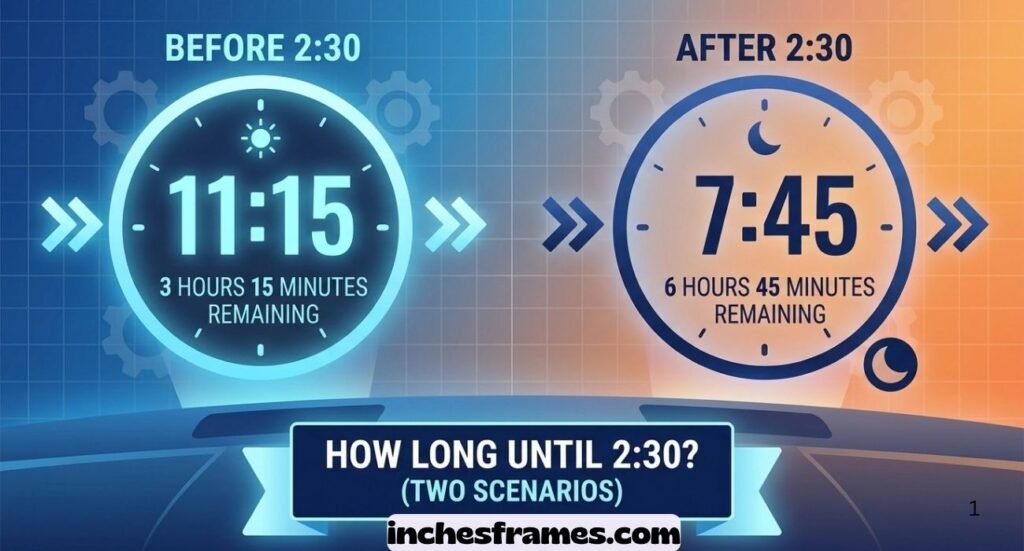
“How long until 2:30?” normally means: How much time remains between the current time and 2:30 PM today?
The calculation is straightforward when the current time is earlier than 2:30 PM. You subtract the current time from the target time.
For example:
| Current time | Time remaining until 2:30 PM |
|---|---|
| 8:00 AM | 6 hours 30 minutes |
| 9:00 AM | 5 hours 30 minutes |
| 10:00 AM | 4 hours 30 minutes |
| 11:00 AM | 3 hours 30 minutes |
| 12:00 PM | 2 hours 30 minutes |
| 1:00 PM | 1 hour 30 minutes |
| 1:30 PM | 1 hour |
| 2:00 PM | 30 minutes |
| 2:15 PM | 15 minutes |
| 2:29 PM | 1 minute |
| 2:30 PM | 0 minutes |
These examples assume that the target is 2:30 PM on the same day and that both times are in the same local time zone.
The answer changes every minute and every second. So if your clock says 10:00 AM now, the answer will be different when you check again at 10:01 AM.
What Does “Until 2:30” Mean?
The phrase can have two slightly different meanings.
It may mean the amount of time remaining until today’s 2:30 PM. This is usually what someone means when checking a countdown during the morning or early afternoon.
It can also mean the amount of time until the next occurrence of 2:30, which matters if it is already later than 2:30 PM. For example, at 4:00 PM, today’s 2:30 PM has already passed. If you want the next 2:30 PM, the target is tomorrow.
This distinction becomes especially important when using an automatic time calculator or countdown tool.
How Many Hours Until 2:30 PM?
To find the number of hours until 2:30 PM, compare the current time with 2:30 PM and express the difference in hours and minutes.
For example, from 10:45 AM to 2:30 PM:
10:45 AM → 11:45 AM = 1 hour
11:45 AM → 12:45 PM = 1 hour
12:45 PM → 1:45 PM = 1 hour
1:45 PM → 2:30 PM = 45 minutes
Therefore, the total is 3 hours and 45 minutes.
If you need the answer in minutes, multiply the hours by 60 and add the remaining minutes. Three hours and 45 minutes is 225 minutes.
How Long Until 2:30 PM Changes Every Second
A countdown to 2:30 PM is not a static calculation. It is a changing duration.
Suppose there are exactly 2 hours remaining at one moment. One second later, there are 1 hour, 59 minutes, and 59 seconds remaining. After another minute, there are 1 hour, 58 minutes, and 59 seconds left.
That is why a displayed answer such as “2 hours” is only a snapshot unless it is connected to a live countdown.
The basic time relationships are:
1 hour = 60 minutes
1 minute = 60 seconds
1 hour = 3,600 seconds
For a precise countdown, the current time should include seconds. If your current time is 12:14:20 PM, for example, the remaining duration to 2:30 PM is different from the duration calculated at exactly 12:14:00 PM.
This matters when 2:30 PM is a strict appointment, meeting start, deadline, class time, or scheduled event. A live timer removes the need to repeatedly recalculate the remaining duration.
Ways to Calculate the Time Until 2:30 PM
There are several ways to determine how long until 2:30. The best method depends on how precise the answer needs to be.
For a quick estimate, mental math is usually enough. For an exact result that updates continuously, a countdown tool is more convenient.
Manual calculation
Manual calculation works well when the target is 2:30 PM on the same day.
Start by identifying the current time. Then calculate the duration between that time and 2:30 PM.
For example, suppose it is 9:20 AM.
From 9:20 AM to 10:20 AM is 1 hour.
From 10:20 AM to 11:20 AM is another hour.
From 11:20 AM to 12:20 PM is another hour.
From 12:20 PM to 1:20 PM is another hour.
From 1:20 PM to 2:20 PM is another hour.
From 2:20 PM to 2:30 PM is 10 minutes.
The answer is 5 hours and 10 minutes.
An alternative is to convert both times into minutes after midnight. For 9:20 AM:
9 × 60 + 20 = 560 minutes
For 2:30 PM:
14 × 60 + 30 = 870 minutes
Then:
870 − 560 = 310 minutes
310 minutes equals 5 hours and 10 minutes.
This method is particularly useful when the minutes do not line up neatly.
Using a Countdown Calculator
A countdown calculator can automatically determine the time remaining until 2:30 PM.
A typical calculation requires a target date and time. If the target is today at 2:30 PM, the calculator compares that target with the current date and time and displays the remaining duration.
A useful countdown should account for the user’s local clock and clearly identify whether the target is AM or PM.
A live countdown can be helpful when you are waiting for a meeting, appointment, break, event, class, or other scheduled activity. Instead of calculating the difference repeatedly, you can simply watch the remaining time decrease.
For example, a countdown might display:
1 hour 24 minutes 18 seconds
A few seconds later, it will automatically update.
Using a Duration Calculator
A duration calculator answers a slightly different question. Instead of simply counting down toward a target, it calculates the amount of time between two specified times.
For example:
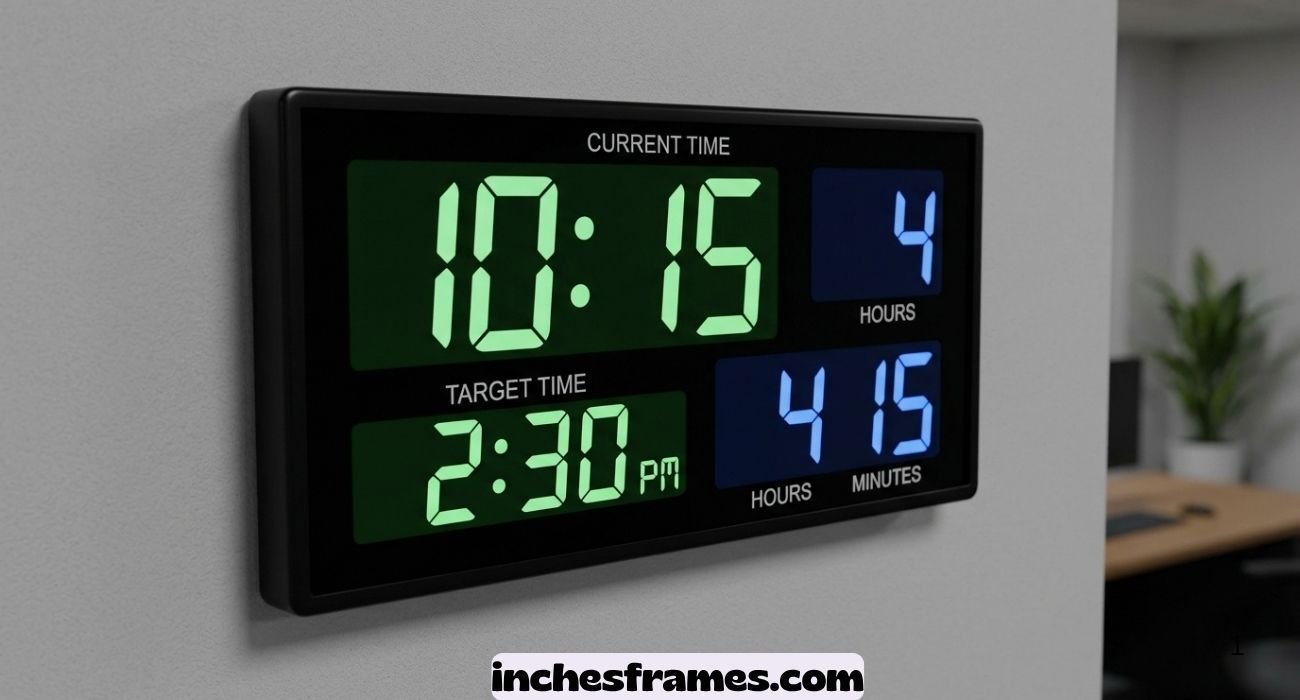
Start: 10:15 AM
End: 2:30 PM
The duration is 4 hours and 15 minutes.
Duration calculations are useful when you want to know how long a work period, study session, appointment, or other time block lasts.
A duration calculator can also be useful when the starting time and target time are on different dates. That is more complicated than a same-day calculation and is where automated tools can reduce arithmetic mistakes.
Understanding 2:30 PM in Different Time Formats
In the 12-hour clock commonly used in the United States, 2:30 PM means 30 minutes after 2 o’clock in the afternoon.
In the 24-hour clock, the same time is written as 14:30.
| Time format | Equivalent |
|---|---|
| 12-hour clock | 2:30 PM |
| 24-hour clock | 14:30 |
| Minutes after midnight | 870 minutes |
The 24-hour format can make calculations easier because it removes the AM/PM distinction.
For example:
2:30 PM = 14:30
If the current time is 11:30 AM, or 11:30 in 24-hour format, the calculation becomes:
14:30 − 11:30 = 3 hours
The most common mistake is confusing 2:30 AM with 2:30 PM. They are 12 hours apart, so checking the AM/PM designation is essential.
Noon can also cause confusion. 12:00 PM is noon, while 12:00 AM is midnight.
Comparing 2:30 PM with Nearby Times
When an appointment or deadline is close to 2:30 PM, thinking in minutes can be more useful than thinking in hours.
At 2:00 PM, there are 30 minutes until 2:30 PM.
At 2:15 PM, there are 15 minutes.
At 2:20 PM, there are 10 minutes.
At 2:25 PM, there are 5 minutes.
At 2:29 PM, there is 1 minute.
At exactly 2:30 PM, the countdown reaches zero.
After 2:30 PM, the target time for that day has passed.
This type of comparison is useful when deciding whether you have enough time to finish a task, travel to an appointment, prepare for a meeting, or take a short break.
How Long Until 2:30 PM From Common Times?
The following reference assumes the same day and the same local time zone:
| Starting time | Remaining time |
|---|---|
| 7:00 AM | 7 hours 30 minutes |
| 8:00 AM | 6 hours 30 minutes |
| 9:00 AM | 5 hours 30 minutes |
| 10:00 AM | 4 hours 30 minutes |
| 11:00 AM | 3 hours 30 minutes |
| 12:00 PM | 2 hours 30 minutes |
| 12:30 PM | 2 hours |
| 1:00 PM | 1 hour 30 minutes |
| 1:30 PM | 1 hour |
| 2:00 PM | 30 minutes |
| 2:15 PM | 15 minutes |
| 2:25 PM | 5 minutes |
| 2:29 PM | 1 minute |
These are fixed examples rather than a live calculation. If you are checking the countdown at an arbitrary moment, the exact result depends on the current time down to the second.
Using a Live Countdown for Better Planning
A live countdown is useful when you need more than a one-time calculation.
If your goal is simply to know whether it is two or three hours until 2:30 PM, mental math may be enough. But if you are actively watching the clock, a live timer provides a continuously updated time remaining value.
Imagine you need to leave for a 2:30 PM appointment. At 1:00 PM, you have 90 minutes until the scheduled time. If getting ready takes 25 minutes and travel takes 35 minutes, that leaves 30 minutes before the appointment.
The countdown itself does not determine whether that schedule is sufficient. It simply gives you an accurate reference point for making your own plans.
This makes a countdown useful for work blocks, breaks, meetings, school schedules, appointments, events, and other activities tied to a specific time.
Time Zones Matter More Than People Think
The question “how long until 2:30?” only has a complete answer when the relevant time zone is known.
If someone says an online meeting starts at 2:30 PM Eastern Time, a person in California should not interpret that as 2:30 PM Pacific Time. The same scheduled event occurs at different local clock times in different U.S. time zones.
The major U.S. time-zone regions include Eastern, Central, Mountain, and Pacific Time, along with Alaska and Hawaii-Aleutian time zones.
For example, an event scheduled for 2:30 PM Eastern Time occurs at:
| U.S. time zone | Local clock time for the same event |
|---|---|
| Eastern | 2:30 PM |
| Central | 1:30 PM |
| Mountain | 12:30 PM |
| Pacific | 11:30 AM |
This is why an online meeting invitation should specify its time zone when participants are spread across different locations.
For a local question such as “how long until 2:30 PM here?”, your local clock is the relevant reference. For an event organized in another location, use the event’s stated time zone.
Daylight Saving Time Can Change Everything
Daylight saving time adds another layer to time-zone calculations.
During daylight saving periods, many parts of the United States move their clocks forward by one hour. When standard time returns, clocks move back by one hour. The resulting UTC offset therefore depends on both the location and the date.
This matters when calculating a future event across a daylight saving transition.
For example, if you are comparing a U.S. time with a different time zone several weeks in the future, you should not always assume that today’s UTC offset will remain unchanged. A reliable time zone calculator uses the applicable rules for the location and date.
Most of the United States observes daylight saving time, while some locations do not. Hawaii does not observe it, and most of Arizona does not observe it.
For a simple countdown to 2:30 PM today, daylight saving time normally does not create a problem as long as your device and countdown tool have the correct local date and time. It becomes more relevant when comparing locations or calculating future dates.
Popular Tools That Help Track the Countdown
A variety of tools can help answer how long until 2:30 without requiring manual arithmetic.
An online countdown timer is useful when you want a visible, continuously changing display. A phone or computer clock is useful for checking the current local time, while a calendar or reminder application is better when you need to remember to do something at 2:30 PM.
The most useful tool depends on the task. If you only need a quick duration, a time calculator is sufficient. If you need seconds, choose a live countdown. If the event is in another location, use a tool with time zone support.
Online Countdown Timers
An online countdown timer can show the remaining hours, minutes, and seconds until a specified target.
For a same-day 2:30 PM target, the process is usually simple: select the appropriate date, enter 2:30 PM, and confirm the local time zone.
The key advantage is that the result keeps updating rather than becoming stale immediately after you calculate it.
Phone and Computer Clocks
Digital clocks are often all you need for a simple calculation.
Your device’s current time provides the starting point, while a timer or alarm can help you track the target. Modern devices also automatically handle their local clock changes when their date, time, and time-zone settings are configured correctly.
If your device displays the wrong local time, however, any countdown based on that clock can also be wrong.
Calendar and Reminder Apps
A calendar is more appropriate when 2:30 PM represents an appointment or event rather than simply a time you are waiting for.
For example, if you have a 2:30 PM meeting, a calendar reminder can alert you beforehand. That can be more practical than keeping a countdown visible for the entire morning.
See Also : What Time Was It 6 Hours Ago? Calculate the Exact Time Easily
Productivity Benefits of Knowing the Exact Countdown
Knowing the time remaining until 2:30 PM can make short-term scheduling easier because you have a clear endpoint for your current activities.
Suppose it is 12:30 PM and you have several tasks to finish before a 2:30 PM meeting. You have two hours available. Instead of treating that period as an undefined block of time, you can divide it into smaller work periods and reserve time for preparation.
The same principle works for breaks. If your lunch break ends at 2:30 PM, a countdown can make the remaining time visible without requiring repeated clock checks.
A useful approach is to work backward from the target. If you need 15 minutes to prepare and 20 minutes to travel, those periods should be considered before the 2:30 PM deadline rather than after it.
The countdown tells you how much time remains. You still need to decide how to use that time.
Morning vs Afternoon Countdowns
The answer to “how long until 2:30?” can feel very different depending on when you check.
In the morning, there may be several hours remaining. Around noon, the remaining duration becomes much shorter. After 2:00 PM, the countdown can be measured in minutes rather than hours.
For example:
At 8:00 AM, 6 hours and 30 minutes remain.
At 10:00 AM, 4 hours and 30 minutes remain.
At noon, 2 hours and 30 minutes remain.
At 1:00 PM, 1 hour and 30 minutes remain.
At 2:00 PM, 30 minutes remain.
At 2:29 PM, only 1 minute remains.
This illustrates why a fixed answer to the query cannot be accurate without knowing when the question is being asked.
Choosing the Right Countdown Tool
The right tool depends on what you actually need from the calculation.
If you simply want to know the duration from your current time to 2:30 PM, a basic time difference calculator is enough. If you want the display to change every second, use a live countdown. If you are planning an event in another location, choose a tool that supports time zones.
If the target is a recurring daily activity, such as a regular meeting at 2:30 PM, a calendar reminder or recurring alarm may be more useful than a one-time countdown.
For a one-off event, the simplest approach is usually best: verify your current local time, confirm whether the target is 2:30 AM or 2:30 PM, and calculate the difference.
What Happens If It Is Already Past 2:30 PM?
If the current time is later than 2:30 PM, today’s target has already occurred.
At 3:00 PM, for example, it is not meaningful to say there are negative 30 minutes until today’s 2:30 PM unless you specifically want to measure how long ago the time passed. If you mean the next 2:30 PM, the target moves to tomorrow.
From 3:00 PM today to 2:30 PM tomorrow is:
9 hours until midnight, plus 14 hours and 30 minutes from midnight to 2:30 PM.
That equals 23 hours and 30 minutes.
Similarly, from 6:00 PM to the next 2:30 PM is 20 hours and 30 minutes.
The important distinction is whether you are asking about a past target or the next occurrence of that target.
Common Mistakes When Calculating the Time Until 2:30 PM
The most common mistake is confusing 2:30 AM with 2:30 PM. Always verify the AM/PM designation before doing the calculation.
Another frequent error is mishandling noon. Remember that 12:00 PM is noon and 12:00 AM is midnight.
Crossing noon can also make mental subtraction less intuitive. Converting the times to the 24-hour clock can help. For example, 11:00 AM becomes 11:00, while 2:30 PM becomes 14:30.
It is also easy to forget that a calculated answer becomes outdated as soon as time passes. If you calculate “2 hours until 2:30 PM” at noon, that answer is no longer correct at 12:10 PM.
For events involving different locations, ignoring the time zone can create an even larger error. Finally, when calculating a target on another date, remember to account for midnight and, when applicable, daylight saving time.
How to Calculate 2:30 PM in Minutes
Converting both the current time and 2:30 PM into total minutes can make the time difference easier to calculate. Since there are 60 minutes in an hour, 2:30 PM is 870 minutes after midnight. If it is 1:00 PM, which is 780 minutes after midnight, the difference is 90 minutes, or 1 hour and 30 minutes.
This method is especially useful when the current time includes unusual minutes, such as 10:17 AM or 1:43 PM. Convert the starting time and target time into minutes, subtract the smaller value from the larger one, and then convert the result back into hours and minutes if needed.
How Many Seconds Until 2:30 PM?
When you need an exact countdown, you can express the remaining time in seconds instead of hours and minutes. Since one hour contains 3,600 seconds, a period of 1 hour and 30 minutes equals 5,400 seconds. A live countdown timer can perform this conversion automatically and update the number as each second passes.
Seconds become particularly useful when 2:30 PM is the exact start of a meeting, event, broadcast, appointment, or other scheduled activity. For everyday planning, hours and minutes are usually easier to understand, but seconds provide greater precision when the target time is very close.
See Also : How Long Until 4:30 PM? Simple Time Guide, Examples & Calculator
What If 2:30 PM Is Tomorrow?
If it is already after 2:30 PM and you are asking about the next occurrence, the target becomes 2:30 PM on the following day. For example, if the current time is 5:00 PM, you have 19 hours and 30 minutes until 2:30 PM tomorrow. The calculation crosses midnight, so both the remaining evening and the following afternoon must be included.
This situation shows why the date matters when calculating a time difference. A countdown tool can automatically recognize that today’s target has passed and calculate the next occurrence, while a manual calculation requires you to account for the change from one calendar day to the next.
How Accurate Is a Countdown to 2:30 PM?
The accuracy of a countdown depends on the accuracy of the clock, the selected target time, and the applicable time zone. A countdown based on the correct local date and time can display the remaining duration down to seconds, but the displayed value will naturally change as time continues to pass.
For everyday purposes, a difference of a few seconds may not matter. For scheduled events, deadlines, or appointments, however, it is useful to make sure your device’s clock and local time are correct. When another location is involved, confirm the relevant time zone before relying on the countdown.
Planning Your Day Around the 2:30 PM Countdown
Knowing how much time remains until 2:30 PM can give you a clear endpoint for tasks scheduled earlier in the day. If you have two hours remaining, for example, you could divide that period between completing a task, reviewing your work, and preparing for an afternoon appointment. The countdown provides a simple reference for keeping track of the available time.
The closer it gets to 2:30 PM, the more useful a minute-by-minute view can become. Instead of repeatedly checking the clock, you can use a live countdown to see exactly how much time remains. This can be helpful for meetings, breaks, appointments, classes, deadlines, and other activities that begin at a specific time.
Frequently Asked Questions About How Long Until 2:30
How long until 2:30 PM today?
The exact amount of time until 2:30 PM depends on your current local time. For example, at 1:00 PM there are 1 hour and 30 minutes remaining, while at 2:15 PM there are 15 minutes remaining.
How many minutes until 2:30 PM?
Convert the remaining hours to minutes and add any remaining minutes. For example, 2 hours and 30 minutes equals 150 minutes.
What time is 2:30 PM in 24-hour time?
2:30 PM is 14:30 in the 24-hour clock.
How long until 2:30 PM from 1:30 PM?
There is exactly 1 hour between 1:30 PM and 2:30 PM.
How long until 2:30 PM from noon?
From 12:00 PM to 2:30 PM is 2 hours and 30 minutes, or 150 minutes.
What if it is already after 2:30 PM?
If today’s 2:30 PM has passed and you mean the next occurrence, the target is generally 2:30 PM tomorrow. The exact duration depends on the current time.
Does my time zone affect how long until 2:30?
Yes, when 2:30 PM refers to a scheduled time in a particular location. A 2:30 PM event in Eastern Time occurs at a different local clock time in Central, Mountain, or Pacific Time.
Can a countdown show seconds until 2:30 PM?
Yes. A live countdown can display the remaining hours, minutes, and seconds and update as time passes.
Is 2:30 PM afternoon or evening?
2:30 PM is generally considered afternoon. It occurs two and a half hours after noon.
How do I calculate the exact time remaining until 2:30 PM?
Use the current local time as the starting point and subtract it from 2:30 PM. For greater precision, include seconds. A live countdown calculator can perform and continuously update this calculation automatically.
Final Thoughts: Calculate the Exact Time Until 2:30 PM
The answer to how long until 2:30 depends on the exact moment you check. If the current time is before 2:30 PM, subtract the current time from 2:30 PM to find the remaining duration. If 2:30 PM has already passed, determine whether you mean the time that has elapsed or the next 2:30 PM tomorrow.
For simple calculations, mental math or a duration calculator is enough. For an exact, continuously changing answer, a live countdown timer is more practical. When the calculation involves different locations or future dates, also check the time zone and daylight saving rules.
The key is simple: 2:30 PM is a fixed clock time, but the time remaining until it is always changing. Verify your current local time, use the correct AM/PM designation, and choose a countdown or calculation method that matches the precision you need.