What Time Was It 6 Hours Ago? Calculate the Exact Time Easily
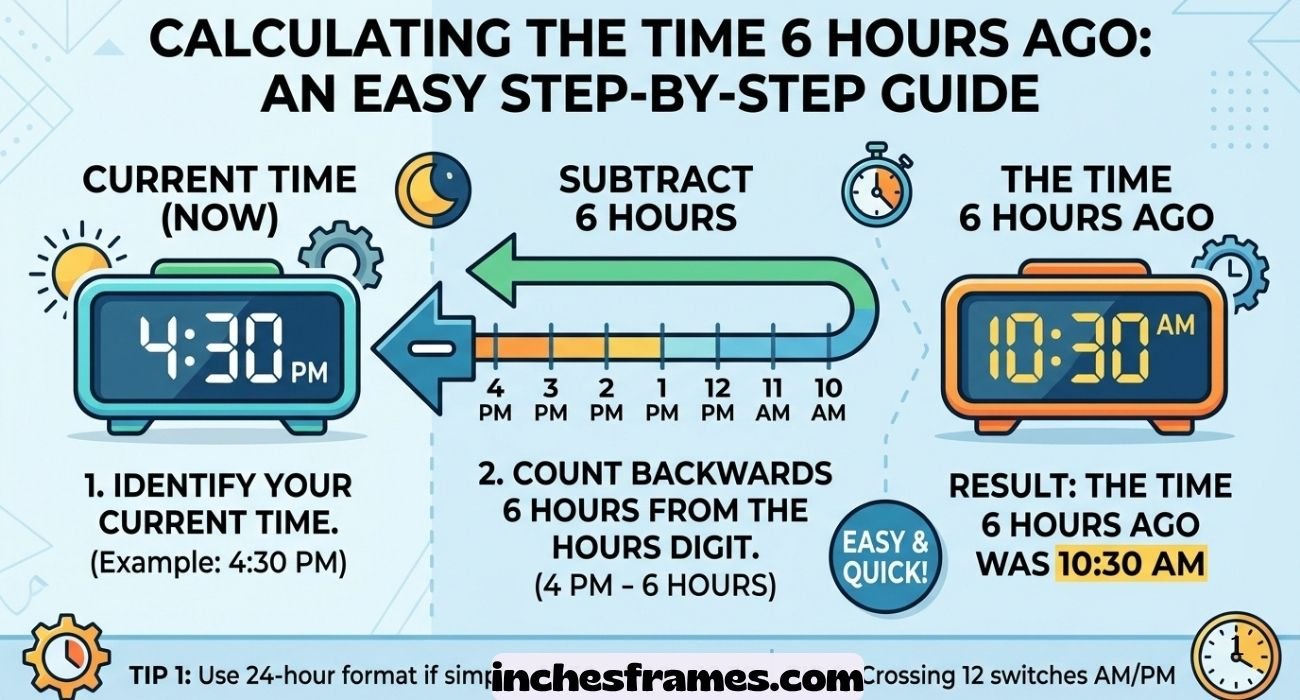
If you are asking “What time was it 6 hours ago?”, the basic answer is simple: subtract six hours from the current time. For example, if it is 4:00 PM now, six hours ago it was 10:00 AM. If it is 3:00 AM, six hours ago it was 9:00 PM on the previous day.
The calculation becomes slightly more important when you cross midnight, switch between AM and PM, or compare times in different time zones. The minutes usually stay exactly the same when you subtract six whole hours, but the date may change.
This guide explains how to calculate six hours ago manually, how the calculation works with both the 12-hour and 24-hour clock, when an hours ago calculator can help, and how to avoid common mistakes involving dates, AM/PM, and local time.
Understanding What Time Was It 6 Hours Ago
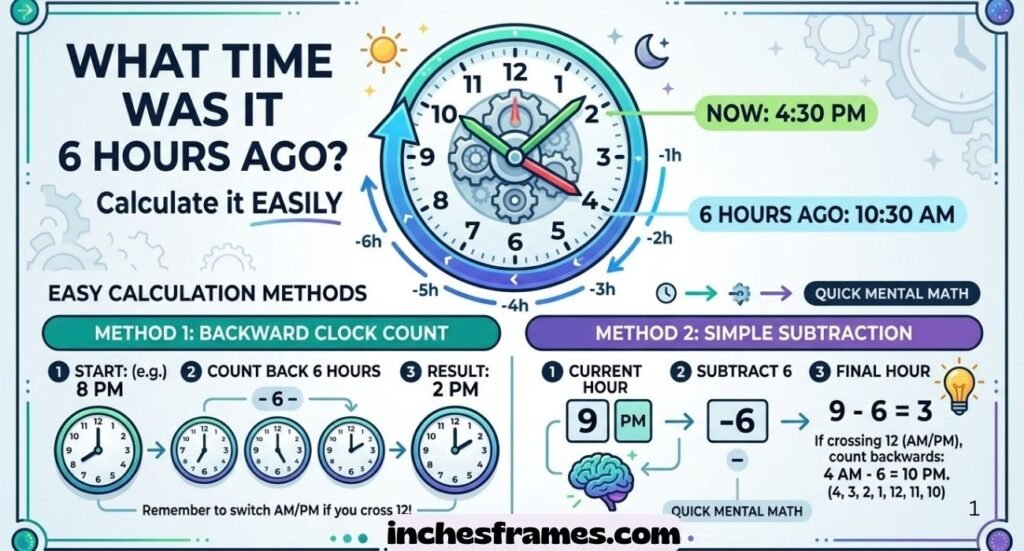
“What time was it 6 hours ago?” means you want to find the point in time that occurred exactly six hours before a particular starting time.
The basic formula is:
Current time − 6 hours = time 6 hours ago
Suppose the current time is 2:30 PM. Move backward six hours:
2:30 PM → 1:30 PM → 12:30 PM → 11:30 AM → 10:30 AM → 9:30 AM → 8:30 AM
So, six hours ago was 8:30 AM.
Notice that the minutes did not change. Because you are subtracting exactly six hours, 30 minutes remains 30 minutes.
The date needs more attention. If the current time is 4:15 AM on October 2, moving backward six hours takes you to 10:15 PM on October 1. The clock time is 10:15 PM, but the complete answer includes the previous date.
This is why an exact answer to “what was 6 hours ago from now?” can require more than simply looking at the hour on a clock. You need to consider the current time, date, and, when relevant, the time zone.
How to Calculate 6 Hours Ago
Calculating six hours earlier is straightforward when you follow the same process each time. Start with the exact time, subtract six from the hour, and then check whether you crossed midnight.
Step 1: Check the Current Time
First, identify the current time you are using. Write down the hour and minutes, along with AM or PM.
For example:
Current time: 7:45 PM
The starting point is 7:45 PM. Since the calculation involves a whole six hours, the 45 minutes will remain unchanged.
If the calculation involves an actual event rather than the moment you are reading this article, use the timestamp associated with that event. A message, appointment, transaction, or activity log may have its own recorded time.
For the most accurate result, also identify the date and local time zone when the event involves people or systems in different locations.
Step 2: Subtract Six Hours
Now move six hours backward.
For 7:45 PM:
7:45 PM − 6 hours = 1:45 PM
For 11:20 AM:
11:20 AM − 6 hours = 5:20 AM
For 9:10 AM:
9:10 AM − 6 hours = 3:10 AM
The key rule is simple: when subtracting exactly six hours, the minutes and seconds do not change.
So:
- 8:37 PM → 2:37 PM
- 6:12 AM → 12:12 AM
- 10:55 AM → 4:55 AM
If you are working with seconds, the same principle applies. For example, 5:24:18 PM minus six hours is 11:24:18 AM.
Step 3: Check Whether the Date Changes
This is the step people most often overlook.
If the current time is between midnight and 5:59 AM, subtracting six hours takes you into the previous calendar day.
For example:
3:00 AM on October 2 − 6 hours = 9:00 PM on October 1
Likewise:
5:30 AM on October 2 − 6 hours = 11:30 PM on October 1
The calculation is not wrong simply because the answer has a different date. The six-hour period crossed midnight.
A useful way to think about it is that a calendar day runs continuously from midnight to the next midnight. Moving backward from an early-morning time can take you across that boundary.
See Also : 500 Grams- Things with Pic That Weigh 500g
Why People Search “What Was 6 Hours Ago From Now”
People search “what was 6 hours ago from now” for many practical reasons. Sometimes they remember when something happened but need to translate a relative period into a clock time. In other cases, they are checking an activity timestamp or trying to understand a schedule.
For example, someone who sees a notification saying an activity occurred six hours ago may want to know the actual clock time. Someone reviewing a work log may need to determine when an earlier shift period began. A person checking sleep data may want to convert a relative period into an approximate clock time.
The phrase “6 hours ago from now” is relative, which means its answer depends on the exact moment at which the calculation is made. If you check at 10:00 AM, six hours ago is 4:00 AM. If you check again at 10:20 AM, six hours ago is 4:20 AM.
That is why an exact timestamp is more precise than a phrase such as “six hours ago.”
Everyday Situations Where Time Six Hours Earlier Matters
Time subtraction appears in ordinary schedules, records, and digital systems. Knowing how to calculate six hours earlier can make these situations easier to understand.
Work Shifts
Work schedules often involve specific start and end times, including overnight shifts. If a person begins work at 6:00 AM, six hours earlier was midnight. If a shift begins at 2:00 PM, six hours earlier was 8:00 AM.
The date becomes especially important for overnight work. A person starting a shift at 3:00 AM on Saturday may be looking back to 9:00 PM on Friday when calculating six hours earlier.
For workplace records, always use the time zone associated with the schedule if employees, offices, or systems are in different locations.
Medication Schedule
Time calculations can also help people understand an already-established medication schedule. For example, if a prescribed schedule contains a six-hour interval, subtracting six hours can identify the preceding scheduled time.
However, a time calculator should not be used to create or change a medication schedule. The appropriate timing for a particular medicine depends on its instructions and individual circumstances. Follow the medication label or instructions from a qualified healthcare professional.
Sleep Tracking
Sleep trackers, phones, and wearable devices record events using timestamps. If you check your data at 8:00 AM and want to know what time it was six hours earlier, the answer is 2:00 AM.
The same calculation can help when interpreting periods of sleep, waking, movement, or device activity. If the starting time is shortly after midnight, remember that six hours earlier falls on the previous date.
Customer Support
Customer service teams frequently work with timestamps from messages, tickets, calls, and system events. If a support record shows a particular time and someone needs to examine what happened six hours earlier, simple time subtraction can establish the relevant period.
This becomes more complicated when the customer and support team are in different time zones. A system might store an event in UTC while displaying it in a user’s local time.
Flight Schedules
Flight information is another situation where time zones and date changes matter. Departure and arrival times are normally associated with the local time at the relevant airport.
If you are simply calculating six hours earlier than a departure time in the same location, ordinary subtraction works. But if you are comparing that time with an event in another city, you need to account for the difference between the two locations.
A six-hour duration is always six hours, but the clock reading representing that moment can differ from one time zone to another.
Time Arithmetic Made Simple
Time arithmetic becomes easier when you separate the duration from the clock display.
One hour contains 60 minutes, and one minute contains 60 seconds. Therefore, six hours contains:
6 × 60 = 360 minutes
and:
6 × 60 × 60 = 21,600 seconds
When you subtract exactly six hours from a timestamp, you are subtracting 360 minutes or 21,600 seconds. The minute and second portions remain unchanged.
For example:
| Current Time | Six Hours Earlier |
|---|---|
| 12:00 PM | 6:00 AM |
| 2:30 PM | 8:30 AM |
| 6:45 PM | 12:45 PM |
| 10:15 PM | 4:15 PM |
| 1:00 AM | 7:00 PM previous day |
| 4:20 AM | 10:20 PM previous day |
| 5:55 AM | 11:55 PM previous day |
There is another useful way to understand the calculation: think in terms of a continuous timeline rather than just the numbers printed on a clock. A clock resets from 11:59 PM to 12:00 AM, but time itself does not stop or restart. This makes crossing midnight much easier to understand.
Examples Using Both 12-Hour and 24-Hour Clock
The same moment can be written using either the familiar U.S. 12-hour format or the 24-hour clock. The calculation does not change; only the way the time is displayed changes.
12-Hour Clock
The 12-hour system divides a day into two cycles. AM covers the period from midnight through the morning, while PM covers the afternoon and evening.
Consider these examples:
2:00 PM − 6 hours = 8:00 AM
5:30 PM − 6 hours = 11:30 AM
11:15 PM − 6 hours = 5:15 PM
4:45 AM − 6 hours = 10:45 PM on the previous day
The last example demonstrates why AM/PM and the date must be considered together. Starting at 4:45 AM and moving backward six hours crosses midnight.
A common error is to subtract six from the displayed hour without considering the AM/PM cycle. For example, treating 4:45 AM as if it were simply the number 4 can produce an incorrect result. Time is cyclical, so the transition through midnight matters.
24-Hour Clock
The 24-hour clock represents the entire day with hour numbers from 00 through 23. This removes the need for AM and PM labels.
For example:
| 12-Hour Time | 24-Hour Time | Six Hours Earlier |
|---|---|---|
| 3:00 AM | 03:00 | 21:00 previous day |
| 8:30 AM | 08:30 | 02:30 |
| 12:00 PM | 12:00 | 06:00 |
| 3:00 PM | 15:00 | 09:00 |
| 8:30 PM | 20:30 | 14:30 |
| 11:45 PM | 23:45 | 17:45 |
For example, 20:30 minus six hours equals 14:30. Converting 14:30 back into the 12-hour system gives 2:30 PM.
The 24-hour format can make calculations easier because 15:00 clearly means 3:00 PM, while 03:00 clearly means 3:00 AM.
What Time Will It Be in 6 Hours?
“What time will it be in six hours?” is the opposite calculation from “what time was it six hours ago?”
The formula is:
Current time + 6 hours = time six hours from now
For example:
8:00 AM + 6 hours = 2:00 PM
1:30 PM + 6 hours = 7:30 PM
8:45 PM + 6 hours = 2:45 AM the next day
Again, the minutes remain unchanged because exactly six whole hours are being added.
The date can change when adding six hours just as it can when subtracting six hours. An evening starting time may produce an early-morning result on the following day.
The distinction is worth remembering:
Six hours ago = subtract 6 hours.
Six hours from now = add 6 hours.
These phrases sound similar but refer to opposite directions on the timeline.
See Also : Coke Can Dimensions: Size, Height and Length
Time Zones Can Change Everything
A basic six-hour calculation assumes that the starting time and resulting time belong to the same time zone. When different locations are involved, the clock display may change even though the actual elapsed duration remains six hours.
The United States spans several major time zones, including Eastern, Central, Mountain, Pacific, Alaska, and Hawaii-Aleutian time. A clock reading in New York therefore does not necessarily match the clock reading in Los Angeles at the same moment.
Consider a simple example. Suppose an event occurs at 3:00 PM in one location, and you need to determine what time that same moment is in another location. You cannot automatically treat the two clock readings as identical. You first need to know the time-zone relationship between the locations and whether seasonal clock changes apply.
There is also an important distinction between elapsed time and local clock time. Six hours is a duration. A time such as 3:00 PM is a clock representation of a moment in a particular location.
Daylight saving time can add another layer of complexity. In areas that observe it, the relationship between two locations can change during the year. This is one reason software systems often use standardized timestamps such as UTC internally and convert them into local time for display.
If you only need to know what time it was six hours ago on your own clock, you usually do not need to perform a time-zone conversion. If you are comparing locations, scheduled events, or timestamps from different systems, the time zone should be part of the calculation.
Technology Depends on Accurate Time Calculation
Computers deal with time constantly. Websites record visits, messaging systems record sent times, applications create activity logs, and scheduling tools organize appointments using timestamps.
A timestamp represents a particular date and time associated with an event. Depending on the system, it may be displayed in local time or stored using a standardized representation such as UTC.
This distinction matters when interpreting records. A server might record an event using one time standard while an application converts that event into the user’s local clock time.
Digital clocks also introduce practical considerations. A device may have an incorrect clock, an incorrect time-zone setting, or a setting that has not updated correctly after a clock change. In those circumstances, a mathematically correct subtraction can still produce the wrong real-world answer because the starting time was wrong.
Online timers and productivity tools use the same underlying principles. Whether you are looking at a countdown timer, an activity history, or a scheduled event, accurate timekeeping depends on a correct starting point.
For ordinary personal calculations, however, the process remains simple: identify the correct time and move six hours backward.
Using an Hours Ago Calculator
An hours ago calculator can perform the subtraction automatically. This is particularly useful when you are working with an exact timestamp, crossing midnight, or checking several calculations.
The basic process is:
- Enter the starting date and time.
- Select or enter 6 hours as the duration to subtract.
- Confirm the applicable time zone if the calculator provides that option.
- Read the resulting time and date.
For example, if you enter 2:35 AM and subtract six hours, the result is 8:35 PM on the previous day.
A calculator is useful because it reduces the chance of simple arithmetic mistakes. It is especially convenient when the calculation includes dates, seconds, or multiple time zones.
However, a calculator cannot fix an incorrect starting time. If a device says 10:00 AM when its clock or time-zone setting is wrong, an otherwise accurate calculator will still calculate from the wrong input.
For a basic question such as “what time was it 6 hours ago?”, manual subtraction is usually enough. For repeated calculations or more complicated timestamps, a time calculator can save time.
Common Mistakes People Make
Even though subtracting six hours is simple, a few predictable mistakes can lead to an incorrect answer.
Forgetting the Date
The most common issue is calculating the clock time correctly but forgetting that the calculation crossed midnight.
For example:
2:00 AM on October 2 − 6 hours = 8:00 PM on October 1
Writing only “8:00 PM” leaves out an important part of the answer.
Mixing Up AM and PM
AM and PM identify different halves of the day. Confusing them can create a 12-hour error.
For example, six hours before 2:00 PM is 8:00 AM, not 8:00 PM.
Using the 24-hour clock can help avoid this particular ambiguity because 14:00 clearly identifies 2:00 PM.
Changing the Minutes
When subtracting exactly six hours, do not alter the minutes.
If the current time is 9:47 AM:
9:47 AM − 6 hours = 3:47 AM
It is not 3:00 AM, 3:41 AM, or 3:53 AM.
The same applies to seconds. If the starting timestamp is 9:47:22 AM, six hours earlier is 3:47:22 AM.
Ignoring Time Zones
A clock reading is meaningful in a particular location or time standard. If you are comparing an event in one city with an event in another, make sure you know which time zone each timestamp uses.
This is particularly relevant for flights, international meetings, remote work, online events, and computer logs.
Confusing Six Hours Ago With Six Hours From Now
These two expressions point in opposite directions.
If it is 10:00 AM:
Six hours ago = 4:00 AM
Six hours from now = 4:00 PM
The easiest rule is to remember ago means move backward, while from now means move forward.
Why Relative Time Feels Different From Exact Time
Expressions such as “six hours ago,” “yesterday,” and “earlier today” are examples of relative time. Their meaning depends on a reference point.
If someone says, “That happened six hours ago,” the statement does not identify a fixed clock time forever. At 10:00 AM, six hours ago means 4:00 AM. At 11:00 AM, six hours ago means 5:00 AM.
An exact timestamp, such as October 2 at 4:00 AM, does not shift as the reader’s current time changes.
This difference explains why relative timestamps are convenient for everyday interfaces. A person may find “6 hours ago” easier to understand at a glance than a full date and time. But when exact documentation matters, the underlying timestamp and date provide more precise information.
Relative time also becomes less clear when the date or time zone is missing. Saying “six hours ago” does not, by itself, tell someone which time zone is being used. If an event crosses midnight, it may not even belong to the same calendar day.
The safest approach is to use relative time for quick context and an exact timestamp when precision is required.
How to Work Out 6 Hours Ago Without a Calculator
When the time is easy to read, you can find what time was it 6 hours ago mentally. Start with the current hour and count backward six hours while keeping the minutes unchanged. For example, if the current time is 6:25 PM, moving back six hours gives you 12:25 PM.
If the calculation crosses midnight, remember that the result belongs to the previous day. For instance, 3:15 AM minus six hours is 9:15 PM on the previous day. This simple method is useful when you need a quick answer and do not have a time calculator available.
What Happens When 6 Hours Ago Crosses Midnight?
Crossing midnight does not change the length of the six-hour period, but it does change the calendar date. If it is 2:00 AM on Tuesday, six hours earlier was 8:00 PM on Monday. The clock moves backward normally; only the date needs to be adjusted.
This is one reason an answer such as “8:00 PM” can be incomplete. If the calculation crosses midnight, include the previous date so the result identifies the correct moment. This matters when checking appointments, messages, work records, travel schedules, or other time-sensitive events.
How Minutes and Seconds Affect the 6-Hour Calculation
Subtracting exactly six hours does not normally change the minutes or seconds. If the current time is 11:42 AM, six hours earlier was 5:42 AM. Similarly, 11:42:18 AM becomes 5:42:18 AM when exactly six hours are subtracted.
The important distinction is between subtracting a whole number of hours and subtracting a total duration that also includes minutes or seconds. If you need to calculate something such as six hours and 30 minutes ago, the minutes must also be adjusted. For exactly six hours, however, the minute and second values remain unchanged.
How 6 Hours Ago Works Across Different Days
A six-hour period can remain within the same calendar day or extend into the previous day. The result depends entirely on the starting time. Times from 6:00 AM through 11:59 PM generally remain on the same date when six hours are subtracted, while earlier morning times can move into the previous date.
For example, 10:00 PM on Friday becomes 4:00 PM on Friday, while 4:00 AM on Saturday becomes 10:00 PM on Friday. Understanding this day-to-day relationship makes it easier to interpret relative time shown by websites, apps, notifications, and activity logs.
When Should You Use a 6-Hour Time Calculator?
A manual calculation is usually enough for a straightforward question such as 2:00 PM minus six hours. However, a 6-hour time calculator can be useful when you are working with exact dates, seconds, multiple timestamps, or different time zones. It can also help verify a calculation when accuracy matters.
The key is to enter the correct starting date, time, and time zone. A calculator can perform the arithmetic accurately, but it still depends on accurate information from the user or device. For simple everyday questions, manual subtraction works well; for more detailed calculations, a calculator can reduce the chance of mistakes.
Quick Reference for Six Hours Earlier
The following reference assumes the calculation is being made within the same time zone and that the minutes remain unchanged.
| Current Time | What Time Was It 6 Hours Ago? |
|---|---|
| 12:00 AM | 6:00 PM previous day |
| 1:00 AM | 7:00 PM previous day |
| 2:00 AM | 8:00 PM previous day |
| 3:00 AM | 9:00 PM previous day |
| 4:00 AM | 10:00 PM previous day |
| 5:00 AM | 11:00 PM previous day |
| 6:00 AM | 12:00 AM |
| 7:00 AM | 1:00 AM |
| 8:00 AM | 2:00 AM |
| 9:00 AM | 3:00 AM |
| 10:00 AM | 4:00 AM |
| 11:00 AM | 5:00 AM |
| 12:00 PM | 6:00 AM |
| 1:00 PM | 7:00 AM |
| 2:00 PM | 8:00 AM |
| 3:00 PM | 9:00 AM |
| 4:00 PM | 10:00 AM |
| 5:00 PM | 11:00 AM |
| 6:00 PM | 12:00 PM |
| 7:00 PM | 1:00 PM |
| 8:00 PM | 2:00 PM |
| 9:00 PM | 3:00 PM |
| 10:00 PM | 4:00 PM |
| 11:00 PM | 5:00 PM |
To use the table with minutes, simply keep the minutes the same. If the current time is 8:42 PM, six hours earlier was 2:42 PM. If the current time is 4:18 AM, six hours earlier was 10:18 PM on the previous day.
Frequently Asked Questions About What Time Was It 6 Hours Ago
What time was it 6 hours ago from now?
The answer is the current time minus six hours. For example, if it is 5:00 PM now, six hours ago it was 11:00 AM. If the subtraction crosses midnight, the answer falls on the previous calendar day.
How do I calculate 6 hours ago?
Subtract six from the current hour while keeping the minutes and seconds unchanged. Then check whether the calculation crossed midnight and therefore moved to the previous date.
What was the time 6 hours ago if it is 3 PM?
Six hours before 3:00 PM was 9:00 AM on the same day.
What time was it 6 hours ago if it is 3 AM?
Six hours before 3:00 AM was 9:00 PM on the previous day. This is a good example of why the date matters when calculating earlier times.
Does subtracting 6 hours change the minutes?
No. When you subtract exactly six whole hours, the minutes and seconds remain unchanged. For example, 10:26 AM becomes 4:26 AM.
Can 6 hours ago be on the previous day?
Yes. If the current time is between 12:00 AM and 5:59 AM, six hours earlier will be on the previous calendar day.
For example:
4:30 AM on October 2 − 6 hours = 10:30 PM on October 1
What is the difference between 6 hours ago and 6 hours from now?
“Six hours ago” means six hours before the current moment. “Six hours from now” means six hours after it.
If the current time is 9:00 AM, six hours ago was 3:00 AM, while six hours from now will be 3:00 PM.
Can time zones affect a six-hour calculation?
Yes, when you are comparing locations or timestamps that use different time zones. A six-hour duration remains six hours, but the displayed clock time can differ by location.
How many minutes are 6 hours?
Six hours equals 360 minutes because 6 × 60 = 360.
How many seconds are 6 hours?
Six hours equals 21,600 seconds because 6 × 60 × 60 = 21,600.
Is there a quick way to find six hours earlier?
Yes. Subtract six hours mentally when the time is simple, or use an hours ago calculator for exact timestamps, date changes, or more complicated calculations.
Conclusion
If you are wondering “what time was it 6 hours ago?”, the calculation is simply:
Current time − 6 hours = time six hours ago
The minutes and seconds stay the same when you subtract exactly six hours. The main details to watch are AM and PM, the date, and the time zone when different locations are involved.
For example, 4:00 PM becomes 10:00 AM, while 4:00 AM becomes 10:00 PM on the previous day. Once you understand how midnight affects the date, calculating six hours earlier becomes quick and reliable.
For a simple calculation, mental time arithmetic is enough. When you need to check exact timestamps repeatedly or account for dates and time zones, an hours ago calculator provides a convenient way to verify the result.