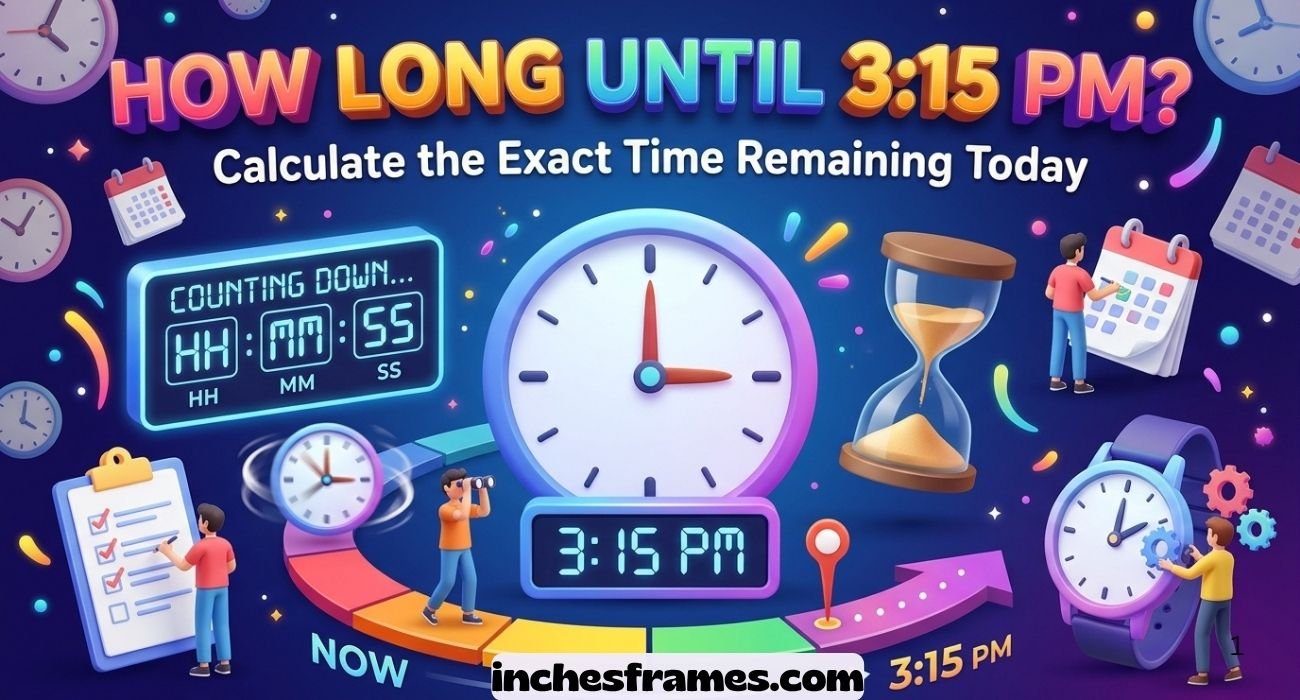
How Long Until 3:15 PM? Calculate the Exact Time Remaining Today
How long until 3:15 PM? The exact time remaining depends on your current local time. For example, if it is 2:15 PM, you have 1 hour left. If it is 2:45 PM, only 30 minutes remain. You can calculate the time until 3:15 PM by subtracting the current time from the target time.
Knowing the time remaining until 3:15 PM can help you prepare for a work meeting, finish school assignments, reach an appointment, or organize your afternoon activities. A simple clock, time calculator, or countdown timer can help you track the remaining time.
This guide explains how to calculate the exact duration, read a quick answer table, avoid common time calculation mistakes, and understand what happens when 3:15 PM has already passed.
Meaning / Definition
“How Long Until 3:15 PM?” is a question that asks how much time remains between the current time and 3:15 in the afternoon. The answer may be expressed in hours, minutes, and seconds, depending on how precise the calculation needs to be.
For example, if the current time is 1:45 PM, the time remaining until 3:15 PM is 1 hour and 30 minutes. If the current time is 3:05 PM, only 10 minutes remain. These calculations show the difference between the current clock time and the scheduled target time.
The target time, 3:15 PM, also has a 24-hour clock equivalent: 15:15. Both formats represent the same moment on the clock. The 12-hour format uses AM and PM to distinguish morning from afternoon, while the 24-hour format uses numbers from 00:00 to 23:59.
The countdown changes as the current time moves forward. Therefore, a calculation made earlier may not provide the exact remaining duration now. To get an accurate result, check the current local time before calculating.
Meaning in Simple Words
In simple words, asking how long until 3:15 PM means asking how much longer you must wait before the clock reaches that time in the afternoon.
Suppose you finish work at 3:15 PM and check your clock at 2:15 PM. You have one hour left. If you check again at 2:45 PM, you have only 30 minutes left. The target remains the same, but the waiting time becomes shorter.
You can use this method for almost any planned activity. It works for school dismissal, appointments, online classes, work deadlines, travel departures, and personal reminders.
Quick Answer Table
The following table shows how much time remains until 3:15 PM at different starting times. These are example calculations rather than a live countdown.
| Current Time | Time Until 3:15 PM |
|---|---|
| 9:15 AM | 6 hours |
| 10:15 AM | 5 hours |
| 11:15 AM | 4 hours |
| 12:15 PM | 3 hours |
| 1:15 PM | 2 hours |
| 1:45 PM | 1 hour 30 minutes |
| 2:00 PM | 1 hour 15 minutes |
| 2:15 PM | 1 hour |
| 2:30 PM | 45 minutes |
| 2:45 PM | 30 minutes |
| 3:00 PM | 15 minutes |
| 3:05 PM | 10 minutes |
| 3:10 PM | 5 minutes |
| 3:14 PM | 1 minute |
| 3:15 PM | 0 minutes |
The table makes it easy to estimate the time remaining without performing a new calculation for every example. If your current time falls between two listed times, calculate the difference using the same method.
For instance, if it is 2:38 PM, you have 37 minutes until 3:15 PM. If it is 2:58 PM, you have 17 minutes left.
If the current time is later than 3:15 PM, the table no longer represents the next upcoming occurrence. You must calculate the time until 3:15 PM on the following day if that is your intended target.
Real-Life Examples
Calculating the time until 3:15 PM can help you manage everyday activities more effectively. The following examples show how to use a time difference calculator or simple subtraction method in common situations.
Example 1: School or College
Imagine a student whose school day ends at 3:15 PM. The student checks the clock at 1:45 PM and wants to know how much longer the school day will last.
The calculation is straightforward. From 1:45 PM to 2:45 PM is one hour. From 2:45 PM to 3:15 PM is another 30 minutes. Therefore, the student has 1 hour and 30 minutes remaining.
This information can help the student plan study time, finish homework, or prepare for the journey home. It also makes it easier to divide the remaining school day into manageable periods.
Example 2: Work Meeting
Suppose an employee has a meeting scheduled for 3:15 PM. At 2:30 PM, the employee checks the clock to see how much preparation time remains.
There are 45 minutes until the meeting begins. The employee can use this time to review documents, organize notes, and check the meeting link or room location.
A countdown timer can also help the employee monitor the remaining time. However, the employee should allow a few minutes to prepare before the meeting rather than waiting until the exact start time.
Example 3: Appointment
Imagine that you have an appointment at 3:15 PM and check the clock at 2:00 PM. You have 1 hour and 15 minutes before the appointment starts.
This calculation tells you how much time remains before the scheduled appointment, but it does not tell you when to leave home. If your journey takes 35 minutes, you should subtract the travel time and any extra time you want for parking or checking in.
For example, leaving at 2:25 PM would allow 50 minutes before the appointment, which may be enough for a 35-minute journey plus 15 minutes of extra time. Actual travel conditions may change the plan.
Example 4: Online Event
An online class or webinar is scheduled to begin at 3:15 PM. You check the time at 3:00 PM and find that 15 minutes remain.
You can use these 15 minutes to open the event page, test your internet connection, prepare your notes, and check your headphones. This simple countdown helps you avoid rushing at the last moment.
For events with participants in different locations, confirm the time zone shown in the invitation. A meeting scheduled for 3:15 PM Eastern Time may occur at a different local clock time for someone on the West Coast.
Example 5: Travel
Suppose you plan to leave for a train station at 3:15 PM. At 1:45 PM, you have 1 hour and 30 minutes before your planned departure.
You can use this period to pack your bags, check your ticket, arrange transportation, and review your route. However, the countdown only measures the time until departure. It does not guarantee that you will reach the station on time.
A practical plan should include travel time, possible delays, and any required arrival time before the train departs. A clock helps you track the deadline, while a journey planner can help estimate how long the trip may take.
Example 6: Afternoon Break
Imagine that you plan to take an afternoon break at 3:15 PM. At 2:50 PM, you have 25 minutes remaining.
You could use that time to complete a short task, answer an important message, or organize your workspace. Knowing the remaining duration may help you avoid starting a task that requires more time than you have available.
Once the clock reaches 3:15 PM, you can take your planned break. This is a simple way to use time awareness when organizing your workday.
Example 7: Personal Reminder
Suppose you need to call a family member at 3:15 PM. At 2:45 PM, you have 30 minutes before the planned call.
You can set an alarm or calendar notification to remind you when the time arrives. A reminder is especially useful when you are busy with another task and may lose track of the clock.
The countdown tells you how long you must wait, while the reminder helps you remember the activity. Using both can make personal scheduling easier.
See Also : How Long Until 10:40? Countdown to 10:40 AM Today
Synonyms and Related Terms
People use different phrases when searching for the time remaining until a specific clock time. These expressions often describe the same basic calculation, although some refer to a tool rather than the duration itself.
Time until 3:15 PM is a direct alternative to the primary keyword. Countdown to 3:15 PM usually refers to the decreasing amount of time before the target arrives. How many minutes until 3:15 PM asks for the remaining duration in minutes rather than hours and minutes.
Other related expressions include hours and minutes calculation, time remaining today, afternoon countdown, time difference calculator, and 3:15 PM countdown timer. A time calculator can help you subtract two clock times, while an online timer can display a live countdown when configured with the correct target.
These terms are related, but they are not always interchangeable. A clock tells you the current time, a duration calculation tells you how much time separates two moments, and a countdown timer tracks the time remaining until a selected event.
When to Use
Calculating how long until 3:15 PM is useful whenever you have an activity scheduled for that time. It can help you plan the remaining part of your day and decide how to use the available minutes.
Use it for appointments
Check the remaining time before a doctor’s visit, service appointment, interview, or scheduled consultation. The calculation helps you understand how long you have before the appointment begins.
If you need to travel, calculate the journey separately. This prevents you from assuming that the entire countdown is available for preparation.
Use it for school
Students can calculate the time remaining before classes finish, tutoring begins, or an after-school activity starts. Teachers can also use a countdown to manage classroom activities and transitions.
For example, if a class ends at 3:15 PM and the current time is 2:55 PM, students have 20 minutes remaining. They can use that time to complete a task or prepare their materials.
Use it for work
Employees can use the countdown to manage deadlines, afternoon meetings, scheduled calls, and project tasks. Knowing the remaining time makes it easier to decide which tasks can be completed before a meeting begins.
If a meeting starts in 30 minutes, a worker may choose a short task rather than beginning a project that needs an hour of focused work.
Use it for travel
Travelers can calculate the time remaining before a departure, pickup, or planned stop. This is especially helpful when several tasks must be completed before leaving.
Always compare the countdown with the estimated journey duration and any arrival requirements. A target time of 3:15 PM does not automatically mean that leaving at 3:15 PM will get you to your destination on time.
Use it for events
A countdown can help you prepare for a video conference, online class, livestream, appointment, or scheduled activity. It gives you a clear indication of how much preparation time remains.
For events that use another time zone, confirm the organizer’s intended local time. This is particularly important for online events with attendees across the United States.
Use it for daily planning
You can use a time calculation to plan meals, exercise, errands, study sessions, and afternoon breaks. If you know how much time remains before 3:15 PM, you can divide the available period into smaller tasks.
A digital clock, smartphone alarm, or productivity timer can support this routine. The goal is to use the available time sensibly rather than constantly checking the clock.
When NOT to Use
A simple countdown works well when the current time and target are clear. However, you should not rely on an incorrect or outdated calculation when the date, time zone, or AM/PM designation is uncertain.
Do not ignore your time zone
The United States has several major time zones, including Eastern, Central, Mountain, and Pacific Time. The same event may occur at different local clock times depending on where you are.
For example, when it is 3:15 PM in New York during a period when the Eastern and Pacific zones are three hours apart, it is 12:15 PM in Los Angeles. If an online meeting invitation specifies Eastern Time, someone in California should convert that time before calculating the countdown.
Use the time zone associated with the actual event. Do not assume that every location follows the same clock.
Do not use yesterday’s calculation
A countdown calculated yesterday cannot tell you the exact time remaining today. The current time changes continuously, so the calculation must use an up-to-date clock reading.
For example, if you calculated yesterday that 45 minutes remained until 3:15 PM, that result does not apply automatically today. Check the current local time and calculate again.
Do not confuse AM and PM
AM and PM distinguish morning from afternoon in the 12-hour clock format. 3:15 AM occurs early in the morning, while 3:15 PM occurs in the afternoon.
Confusing these times can produce a result that differs by 12 hours. For example, if it is 2:15 PM, only one hour remains until 3:15 PM. The same starting clock reading of 2:15 AM is 13 hours before 3:15 PM.
When reading a schedule, always confirm whether the target is AM or PM.
Do not forget the next day
If the current time is later than 3:15 PM, the target for today has already passed. If you mean the next occurrence, you must calculate the duration until tomorrow at 3:15 PM.
For example, if the current time is 4:00 PM, the next 3:15 PM is 23 hours and 15 minutes away. If the current time is 8:00 PM, the next occurrence is 19 hours and 15 minutes away.
This distinction matters for recurring reminders, work schedules, and events that take place every afternoon.
Do not confuse duration with clock time
A clock time identifies a point in the day, such as 3:15 PM. A duration measures the amount of time between two points, such as 45 minutes.
If it is 2:30 PM, the clock time is 2:30 PM and the duration until 3:15 PM is 45 minutes. These values answer different questions.
Understanding the difference helps you read schedules, calculate deadlines, and use countdown tools correctly.
Common Mistakes
Even a simple time calculation can produce an incorrect result if you overlook the hour, minute, date, or current clock reading. Recognizing common mistakes makes it easier to find the correct answer.
Mistake 1: Confusing AM and PM
One common error is using 3:15 AM when the intended target is 3:15 PM. These are different times separated by 12 hours.
Check the time format before performing the calculation. If you use a digital clock with a 24-hour display, 3:15 PM appears as 15:15, which can help prevent confusion.
Mistake 2: Forgetting the hour change
Calculating across an hour boundary requires careful subtraction. For example, from 2:50 PM to 3:15 PM, there are 10 minutes until 3:00 PM and another 15 minutes until 3:15 PM.
The correct total is 25 minutes. Counting the minutes without accounting for the change from 2 PM to 3 PM can lead to mistakes.
Mistake 3: Subtracting minutes incorrectly
When the target minutes are smaller than the starting minutes, it may help to split the calculation into two parts.
Suppose the current time is 2:45 PM. From 2:45 PM to 3:00 PM is 15 minutes. From 3:00 PM to 3:15 PM is another 15 minutes. The total is 30 minutes.
Breaking the calculation into clear intervals is often easier than trying to subtract both clock readings at once.
Mistake 4: Forgetting the next day
If you check the clock at 4:00 PM, today’s 3:15 PM has already passed. The next occurrence is tomorrow, 23 hours and 15 minutes later.
A useful method is to calculate the time from 4:00 PM to midnight, which is 8 hours, and then add 15 hours and 15 minutes from midnight to 3:15 PM the following day. The total is 23 hours and 15 minutes.
Mistake 5: Using an outdated countdown
A manually calculated answer becomes outdated as soon as time passes. If you calculated the remaining time at 2:30 PM, the answer was 45 minutes. At 2:40 PM, only 35 minutes remain.
Refresh your calculation whenever you need a current answer. For ongoing tracking, use a countdown timer that updates automatically.
Mistake 6: Ignoring seconds
A result stated in whole minutes may not show the complete remaining duration. If the current time is 3:14:30 PM, exactly 30 seconds remain until 3:15 PM.
If the current time is 3:14:45 PM, only 15 seconds remain. A display that shows only whole minutes may round or truncate the value, depending on the tool.
For second-by-second accuracy, use a reliable clock or live countdown. Remember that the displayed result depends on the clock’s accuracy and how the timer updates.
See Also : How Long Until 2:00 PM? Calculate the Exact Time Remaining Today
Comparison with Similar Terms
Several methods can express the duration until 3:15 PM. Choosing the right format depends on whether you need a quick estimate, a detailed calculation, or a continuously updating display.
| Method | Example | Best Use |
|---|---|---|
| Hours and minutes | 1 hour 30 minutes | Understanding a longer duration |
| Total minutes | 90 minutes | Comparing or calculating durations |
| Clock time | 1:45 PM | Identifying a point in the day |
| Countdown timer | 00:30:00 | Tracking a live 30-minute period |
| Elapsed time | 45 minutes have passed | Measuring time that has already gone by |
The formats can describe the same period in different ways. For example, 1 hour and 30 minutes equals 90 minutes. The first format separates hours from minutes, while the second expresses the entire duration as minutes.
Hours and Minutes vs. Total Minutes
Hours and minutes are usually easy to understand because they resemble the way people speak about time. If you have 2 hours and 15 minutes before an event, you can quickly recognize the length of the waiting period.
Total minutes are useful when comparing durations or performing calculations. Two hours and 15 minutes equal 135 minutes because two hours contain 120 minutes, and adding another 15 gives 135.
Here are a few common conversions:
| Hours and Minutes | Total Minutes |
|---|---|
| 15 minutes | 15 minutes |
| 30 minutes | 30 minutes |
| 45 minutes | 45 minutes |
| 1 hour | 60 minutes |
| 1 hour 15 minutes | 75 minutes |
| 1 hour 30 minutes | 90 minutes |
| 2 hours | 120 minutes |
| 2 hours 30 minutes | 150 minutes |
Both formats are correct. Use hours and minutes when you want a familiar description, or total minutes when a single number makes the calculation easier.
A Simple Calculation Method
You can calculate the time remaining until 3:15 PM without using a special tool. The easiest method depends on whether the current time is before or after the target.
When the current time is before 3:15 PM on the same day, subtract the current time from the target. For example, if the clock shows 12:45 PM, there are 15 minutes until 1:00 PM, one hour until 2:00 PM, and another hour until 3:00 PM, followed by 15 minutes until 3:15 PM. The total is 2 hours and 30 minutes.
You can also use the following table to check common calculations.
| Current Time | Calculation | Remaining Time |
|---|---|---|
| 12:45 PM | 15 minutes to 1:00 PM, then 2 hours 15 minutes | 2 hours 30 minutes |
| 1:30 PM | 1 hour to 2:30 PM, then 45 minutes | 1 hour 45 minutes |
| 2:15 PM | 3:15 PM minus 2:15 PM | 1 hour |
| 2:40 PM | 20 minutes to 3:00 PM, then 15 minutes | 35 minutes |
| 3:05 PM | 3:15 PM minus 3:05 PM | 10 minutes |
| 4:00 PM | Calculate until tomorrow’s 3:15 PM | 23 hours 15 minutes |
For a more formal calculation, convert both times into minutes after midnight. The target time, 3:15 PM, equals 915 minutes after midnight because 15 hours multiplied by 60 equals 900, and adding 15 minutes gives 915.
If the current time is 2:40 PM, it equals 880 minutes after midnight. Subtracting 880 from 915 gives 35 minutes.
This method works well with a time calculator and can also be used in a spreadsheet or a small program. If the target is on the following day, account for the date change before calculating the total duration.
How Long Until 3:15 PM After the Time Has Passed?
If the current time is later than 3:15 PM, the time remaining until today’s target is zero because that moment has already passed. However, if you want to know how long until 3:15 PM occurs again, calculate the time until tomorrow’s target.
For example, at 3:20 PM, today’s 3:15 PM passed five minutes ago. The next occurrence is tomorrow, 23 hours and 55 minutes away.
The following table shows more examples.
| Current Time | Time Until the Next 3:15 PM |
|---|---|
| 3:20 PM | 23 hours 55 minutes |
| 4:00 PM | 23 hours 15 minutes |
| 6:00 PM | 21 hours 15 minutes |
| 8:00 PM | 19 hours 15 minutes |
| 10:00 PM | 17 hours 15 minutes |
| 11:00 PM | 16 hours 15 minutes |
| 11:45 PM | 15 hours 30 minutes |
You can calculate the next day’s duration by finding the time remaining until midnight and adding 15 hours and 15 minutes. This works because 3:15 PM is 15 hours and 15 minutes after midnight.
For example, from 10:00 PM to midnight is two hours. From midnight to 3:15 PM is 15 hours and 15 minutes. The total is 17 hours and 15 minutes.
Be clear about what you mean when asking how long until 3:15 PM. You may be asking how long remains until today’s target, how long ago it occurred, or how long until the next occurrence. These are different calculations.
Why Local Time Matters
Your local time determines the answer to the question “How long until 3:15 PM?” If the current clock reads 2:15 PM, one hour remains. If it reads 2:45 PM, only 30 minutes remain.
Time zones become important when the target belongs to a different location. The United States observes several major time zones, including Eastern, Central, Mountain, and Pacific Time. A meeting scheduled for 3:15 PM in one zone may occur at a different clock time elsewhere.
For example, when New York is three hours ahead of Los Angeles, an event scheduled for 3:15 PM in New York takes place at 12:15 PM in Los Angeles. Someone in Los Angeles who needs to join that event should calculate the countdown using the converted local event time or a clock configured for the event’s time zone.
Daylight saving time can also affect the difference between locations. Some regions change their clocks seasonally, while others do not. The time difference between two places may therefore change during the year.
For accurate scheduling, confirm the date, event time, and time zone. Use the event’s specified time rather than assuming that the clock time is the same everywhere.
Why a Countdown Can Improve Time Management
A countdown gives you a clear view of how much time remains before a scheduled activity. Instead of guessing whether you have enough time, you can calculate the available period and plan your next steps.
For example, if a meeting begins at 3:15 PM and the current time is 2:45 PM, you have 30 minutes. You might spend 20 minutes reviewing your notes and reserve the final 10 minutes to prepare your workspace and open the meeting link.
The same approach works for studying, cooking, completing household tasks, or preparing for travel. A countdown can help you decide whether to begin a task, finish something already in progress, or postpone an activity that requires more time.
A digital clock or productivity timer can make this process easier by showing the time as it changes. A smartphone reminder or calendar notification can provide an additional prompt when the target time arrives.
However, a countdown is only a planning aid. It does not account automatically for traffic, unexpected delays, or the time needed to complete a task. Combine the remaining-time calculation with realistic estimates so your schedule stays practical.
Frequently Asked Questions
How many minutes are left until 3:15 PM?
The number of minutes remaining depends on the current time. If it is 3:00 PM, 15 minutes remain. If it is 2:45 PM, 30 minutes remain. Check your current local time and subtract it from 3:15 PM to find the exact duration.
How many hours until 3:15 PM?
The answer depends on when you start counting. At 12:15 PM, three hours remain. At 1:15 PM, two hours remain, and at 2:15 PM, one hour remains. If the current time includes additional minutes, express the result in hours and minutes.
What time is 30 minutes before 3:15 PM?
Thirty minutes before 3:15 PM is 2:45 PM. Subtracting 15 minutes gives 3:00 PM, and subtracting another 15 minutes gives 2:45 PM.
What time is 15 minutes after 3:15 PM?
Fifteen minutes after 3:15 PM is 3:30 PM. Adding 15 minutes to the target time gives the new clock time.
What if it is already past 3:15 PM?
If 3:15 PM has already passed, today’s target is in the past. If you want the next occurrence, calculate the duration until 3:15 PM tomorrow. For example, at 4:00 PM, the next occurrence is 23 hours and 15 minutes away.
How do I calculate the time until 3:15 PM without a calculator?
Check the current time and count forward to the target. If it is 2:30 PM, count 30 minutes to 3:00 PM and another 15 minutes to 3:15 PM. The total is 45 minutes. For longer periods, count in one-hour steps before adding the remaining minutes.
Is 3:15 PM the same as 15:15?
Yes. 3:15 PM and 15:15 represent the same clock time. The first uses the 12-hour clock, while the second uses the 24-hour clock. The 24-hour format does not require AM or PM because the hour number distinguishes afternoon times from morning times.
Does the countdown change every second?
Yes. The actual time remaining decreases continuously as time passes. A countdown that displays seconds can show this change more precisely than a manually calculated answer in whole minutes. The displayed accuracy depends on the clock and timer being used.
Does the time zone affect how long until 3:15 PM?
Yes, when 3:15 PM refers to an event in a different time zone. Your current local time may not match the event’s local time. Confirm the event location and time zone, convert the scheduled time if needed, and then calculate the remaining duration.
Conclusion
Knowing how long until 3:15 PM helps you plan your afternoon, prepare for appointments, manage work tasks, and keep track of scheduled events. The exact answer depends on your current local time. For example, 2:15 PM leaves one hour, while 2:45 PM leaves 30 minutes.
To calculate the time remaining accurately, check the clock, confirm AM or PM, and subtract the current time from the target. If 3:15 PM has already passed, calculate the time until the next day’s occurrence when that is your intended target. For ongoing accuracy, use a reliable clock or live countdown timer.