Dollar Bill Dimensions: Size, Height, and Length
Dollar Bill Dimensions tell us the exact size of U.S. paper money. They show the length, width, and thickness of each bill. All bills, from $1 to $100, share the same measurements.
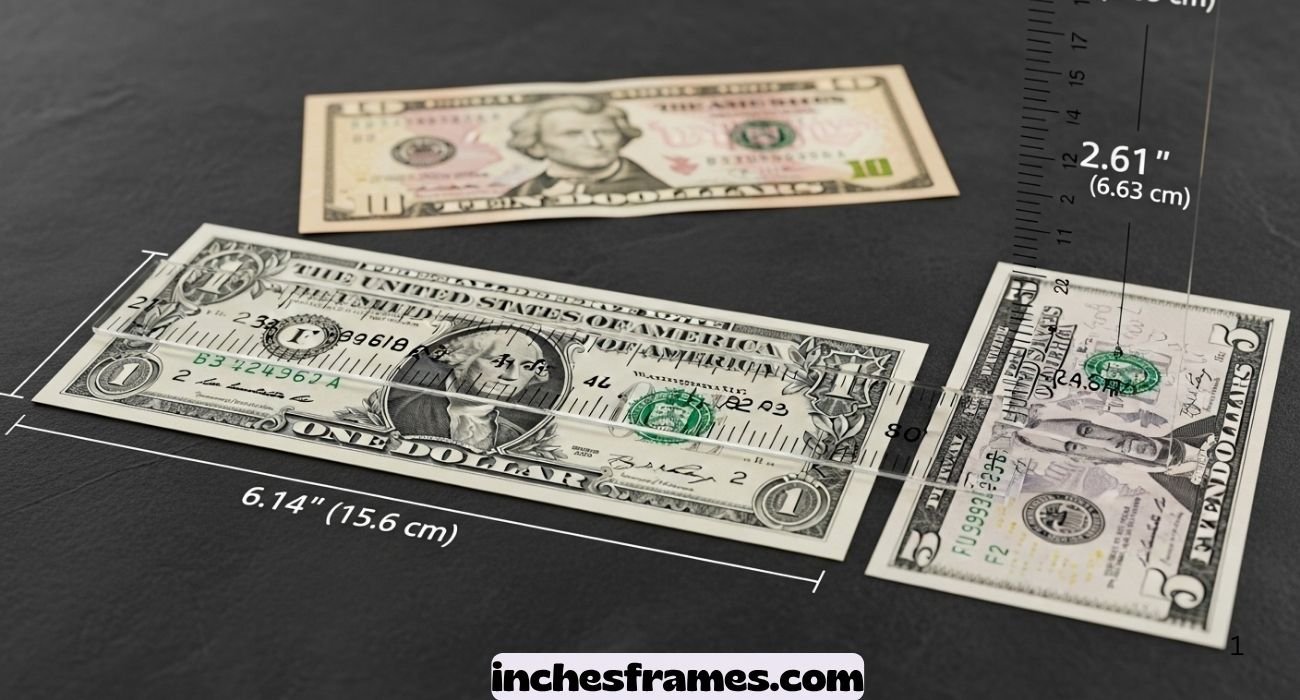
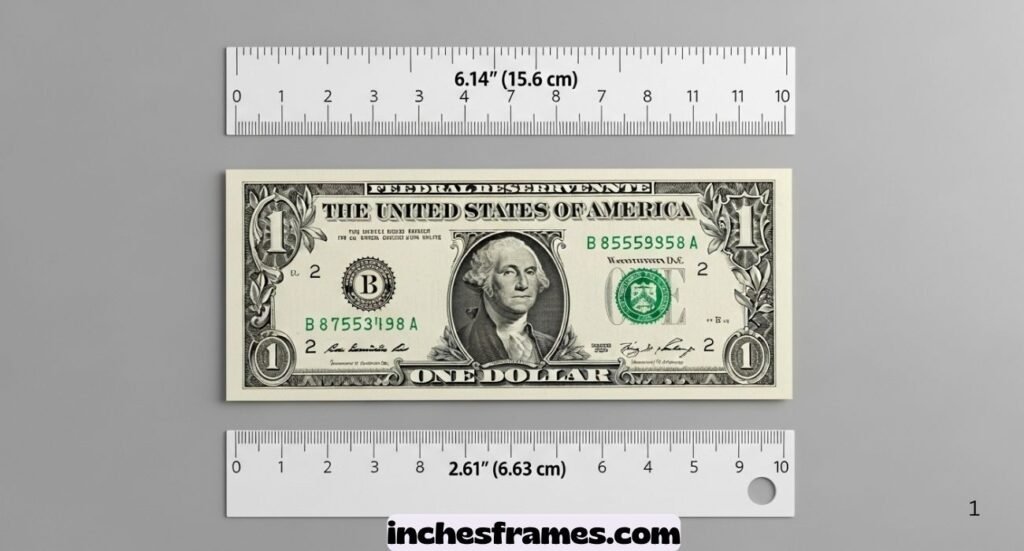
Every U.S. bill is 6.14 inches long and 2.61 inches wide. They are made of strong cotton and linen. These sizes help bills fit in wallets, machines, and cash drawers.
Knowing Dollar Bill Dimensions is useful for counting, stacking, and collecting money. The thickness of a bill is 0.0043 inches. All bills are uniform, making them easy to use every day.
Dollar Bill Dimensions in Different Units
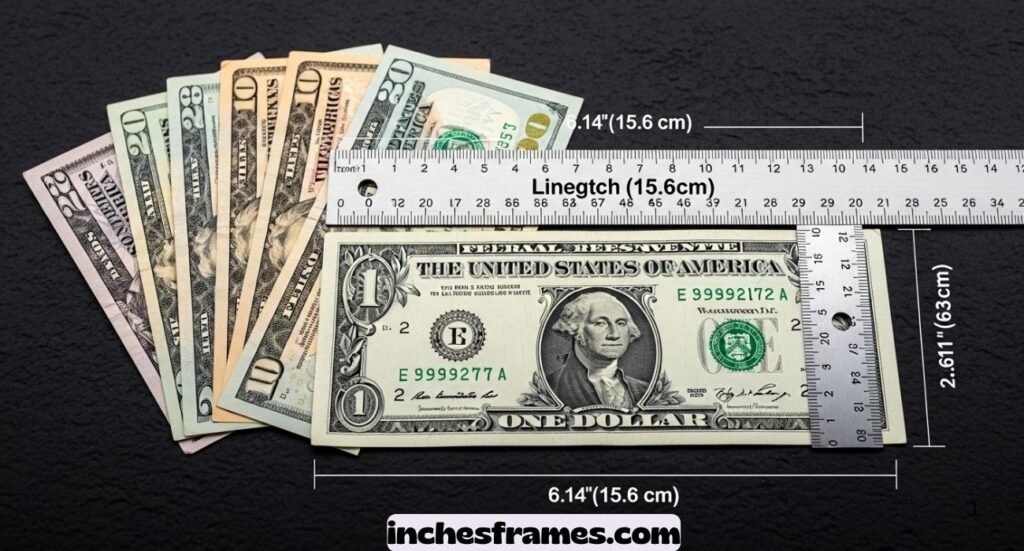
A standard U.S. bill is very specific in its measurements. The dollar bill length is 6.14 inches, and the dollar bill width is 2.61 inches. In metric units, this is 156 millimeters long and 66.3 millimeters wide. The dollar bill thickness is 0.0043 inches, or approximately 0.109 millimeters. These numbers may seem small, but they are carefully designed to make U.S. banknotes ATM-compatible bills and easy to handle. Every bill, from the $1 to the $100, follows these paper money dimensions, which also ensures currency uniformity for vending machines, cash registers, and wallets.
The U.S. dollar size is slightly larger than a standard credit card but smaller than a smartphone in portrait mode. The choice of dimensions combines practicality with durability, as cotton-linen currency can withstand thousands of folds without tearing. These measurements have been maintained for decades and are essential for collectors, businesses, and anyone handling Federal Reserve notes.
Quick Reference Table
To make understanding these numbers easier, here’s a table summarizing the standard U.S. bill size and paper money dimensions:
| Feature | Inches | Millimeters |
| Length | 6.14 in | 156 mm |
| Width | 2.61 in | 66.3 mm |
| Thickness | 0.0043 in | 0.109 mm |
| Weight | 0.035 oz | 1 g |
For perspective, 10 bills stacked together create a height of just 0.43 millimeters, while 100 bills reach 0.43 inches, less than half an inch. These numbers are important when calculating dollar bill stack height for banking, storage, or display purposes.
Are All Dollar Bill Dimensions the Same?
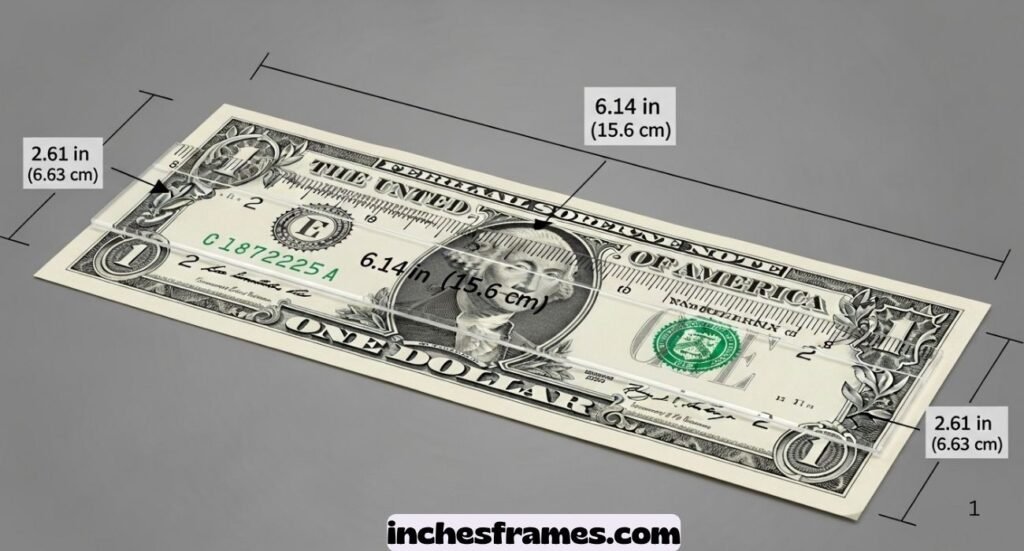
Yes, all denominations of U.S. currency share identical dollar bill dimensions. The $1 bill, $5 bill, $10 bill, $20 bill, $50 bill, and $100 bill all measure the same. This uniformity is unusual compared to other countries that sometimes vary the size of currency for accessibility or denomination differentiation. The decision to maintain currency uniformity ensures ATM-compatible bills and smooth functioning of everyday transactions.
One Size Fits All U.S. Currency
The choice of a one-size U.S. bill simplifies many aspects of the financial system. ATMs, vending machines, and cash-counting machines do not need adjustment for different denominations, and wallets can comfortably hold any bill without special compartments. The U.S. Treasury carefully chose this size during standardization to ensure efficiency, lower production costs, and durability. This wallet-friendly bill size also means collectors and everyday users can handle money easily, while Federal Reserve notes maintain their reliability in all transactions.
Historical Dollar Bill Sizes
Before 1929, American currency was very different. Older bills, known as horse blanket currency, were much larger, sometimes measuring up to 7.4 inches long and 3.1 inches wide. These oversized bills were difficult to carry and did not fit well in wallets, making them impractical for daily use.
The Treasury introduced a U.S. Treasury standardization program that reduced the size of paper money, giving us the small vs large bills we know today. Standardization reduced costs, allowed banks to store more money in the same space, and made bills easier to handle. The historical dollar sizes also help collectors identify older, collectible notes, showing the evolution of American money from oversized to the modern American money size we are familiar with.
Dollar Bill Dimensions by Denomination
Every denomination of U.S. currency follows the standard U.S. bill size, but the designs and portraits differ. The dollar bill dimensions by denomination remain identical to simplify circulation and currency comparison.
Common Denominations
The $1 bill measures 6.14 by 2.61 inches and features George Washington on the front, based on Gilbert Stuart’s famous Athenaeum portrait. The reverse shows the Great Seal of the United States, including the eagle and the unfinished pyramid. The $5 bill, identical in size, features Abraham Lincoln on the front, with the Lincoln Memorial on the reverse and modern purple accents for currency security features.
The $10 bill showcases Alexander Hamilton, with the U.S. Treasury building on the back, making it the only bill without a president. The $20 bill displays Andrew Jackson with the White House behind him and remains the most widely circulated denomination. The $50 bill has Ulysses S. Grant on the front and the U.S. Capitol on the back, with green and peach colors for anti-counterfeit purposes. Finally, the $100 bill features Benjamin Franklin and Independence Hall, with modern blue security threads and color-shifting ink, all while maintaining the same dollar bill dimensions as other bills.
Rare and Discontinued Bills
The $2 bill is still produced but rarely circulates. Thomas Jefferson appears on the front, with the signing of the Declaration of Independence on the back. Despite its rarity, it shares the same American money size as all other denominations. Large bills like $500, $1,000, $5,000, and $10,000 were discontinued in 1969 to reduce organized crime risks. The $10,000 bill featured Salmon P. Chase, Treasury Secretary under Lincoln, and only a few hundred remain in private collections or museums.
Even the $100,000 gold certificate, never released publicly and only used between Federal Reserve banks, measured the same as standard bills. This uniformity in paper money dimensions across all denominations demonstrates the efficiency of Federal Reserve notes.
Dollar Bill Thickness and Stack Height
How Thick Is a Dollar Bill?
A single bill measures just 0.0043 inches thick, or 0.109 millimeters. Unlike regular paper, cotton-linen currency is woven from 75% cotton and 25% linen, giving it superior durability. This composition allows bills to survive thousands of folds without tearing. The weight of a bill is approximately 1 gram, making it light but durable. These money thickness and weight properties make U.S. currency reliable for daily transactions and long-term circulation.
Stack Calculations
Understanding dollar bill stack height helps visualize large sums. Ten bills measure 0.43 millimeters, while 100 bills create a stack of 0.43 inches. A thousand $1 bills reach 4.3 inches, roughly the height of a coffee mug. Ten thousand $1 bills tower at 43 inches, or about 3.5 feet.
Interestingly, a million $1 bills form a stack approximately 358 feet high, taller than the Statue of Liberty, while a million $100 bills compress to just 3.58 feet, compact enough for a large briefcase. These calculations illustrate the practicality of bill measurements in cm/inches and show why U.S. currency measurements are standardized for everyday use.
The Standard Size of U.S. Dollar Bills
The dollar bill dimensions are uniform across all denominations, measuring 6.14 inches in length and 2.61 inches in width. This consistency ensures that U.S. banknotes fit wallets, cash registers, and ATMs without issues. The precise size, combined with the cotton-linen currency blend, makes each bill durable and easy to handle.
Standardization also helps businesses and banks maintain currency uniformity. A consistent U.S. dollar size allows quick stacking, counting, and storage. Every denomination from $1 to $100 shares the same paper money dimensions, making the bills predictable in size and weight while simplifying transactions and machine processing across the United States.
Historical Evolution of Dollar Bill Sizes
Before 1929, U.S. currency included oversized bills known as horse blanket currency, often difficult to carry. These bills could measure over 7 inches long, creating challenges for wallets and banks. The Treasury introduced U.S. Treasury standardization to reduce size while keeping bills functional and durable.
The smaller size preserved materials and improved money thickness and weight management. Standardization marked a turning point in historical dollar sizes, allowing banks to store more bills efficiently. Today, these measures continue to influence dollar bill dimensions, showing how practical considerations shaped the American money size we know today.
How Dollar Bill Thickness Affects Durability
A single U.S. bill has a dollar bill thickness of just 0.0043 inches, thinner than typical printer paper. However, the cotton-linen currency composition allows it to survive thousands of folds. This durability ensures bills remain in circulation longer than standard paper, resisting tears and wear while retaining a crisp feel.
The combination of U.S. currency measurements and material composition affects both durability and handling. Lightweight yet strong, Federal Reserve notes maintain their shape under daily use. Proper bill measurements in cm/inches and thickness standards make U.S. banknotes reliable for transactions and stacking.
Comparing Dollar Bills to Other Currencies
U.S. bills are uniform in size, unlike some international currencies where sizes vary by denomination. The standard U.S. bill size makes currency comparison easy when traveling or exchanging money. Uniform dollar bill length and width simplify counting and sorting compared to variable-size notes abroad.
Additionally, the paper money dimensions allow straightforward visualization of value in stacks. For instance, 100 $1 bills are about 0.43 inches high, while other countries’ currencies may differ significantly. The American money size remains practical, efficient, and globally recognized for consistency and usability.
See Also : Can Koozie Size Dimensions Height and Length
Dollar Bill Stack Height: Understanding Large Sums
Stacking multiple U.S. banknotes illustrates the power of dollar bill stack height. Ten bills are just 0.43 millimeters thick, while 100 bills form a 0.43-inch stack. A thousand $1 bills reach 4.3 inches, roughly the height of a coffee mug, demonstrating practical volume for cash handling.
Large sums show even more striking results. Ten thousand $1 bills stack 43 inches high, and a million bills reach 358 feet, taller than the Statue of Liberty. These calculations highlight how dollar bill thickness and currency uniformity influence storage, transport, and visualization of Federal Reserve notes.
Collectible Bills and Their Dimensions
Some bills are rare or discontinued, including $500, $1,000, $5,000, and $10,000 notes. Despite their rarity, these collectible bills maintain the dollar bill dimensions of modern currency. The size consistency ensures these notes can still be handled safely without special storage needs.
Collectible bills often have unique designs or historical significance. The $2 bill, featuring Thomas Jefferson, is uncommon in circulation. Yet, its American money size and paper money dimensions match standard bills, showing that rarity does not affect physical standards. This consistency is part of U.S. Treasury standardization practices.
Security Features and Bill Size
Modern U.S. banknotes include security features such as color-shifting ink, watermarks, and embedded threads. These currency security features work alongside precise dollar bill dimensions to prevent counterfeiting. The size and layout of each bill allow these measures to be easily integrated without altering usability.
Even high-value bills like the $100 note retain standard U.S. dollar size. Blue security threads, subtle color changes, and fine microprinting are applied consistently thanks to the uniform paper money dimensions. The combination of size and design helps maintain Federal Reserve notes’ integrity and trustworthiness.
Dollar Bill Design by Denomination
Every U.S. bill, from $1 to $100, shares identical dollar bill dimensions, though the design differs. The $1 bill features George Washington, while the $50 displays Ulysses S. Grant. The back designs, such as the Great Seal or the U.S. Capitol, fit precisely within the standard U.S. bill size.
Uniformity in dollar bill length, width, and thickness allows seamless integration of portraits, colors, and security features. This makes Federal Reserve notes functional for ATMs, counting machines, and stacking, while also preserving historical and artistic elements across denominations of American money size.
Practical Uses of Dollar Bill Measurements
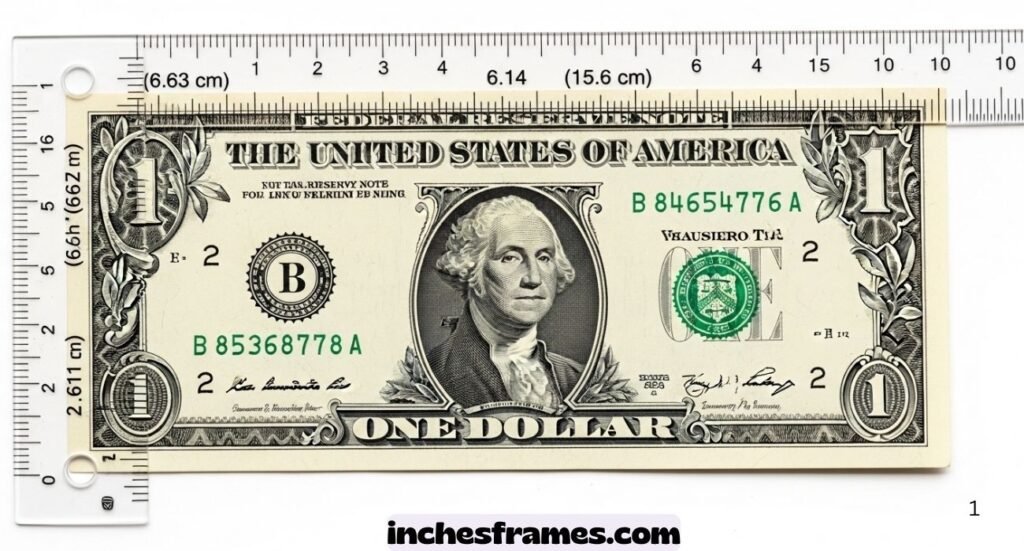
Knowing bill measurements in cm/inches helps businesses, collectors, and educators. For example, cash registers and ATM-compatible bills rely on standard dimensions for smooth transactions. Wallet manufacturers also design compartments around these sizes, showing how dollar bill dimensions affect everyday products.
Collectors benefit as well. Display cases, albums, and storage boxes are built using the standard U.S. bill size. Accurate U.S. currency measurements allow for precise placement and stacking, ensuring bills are protected while retaining the money thickness and weight integrity expected in Federal Reserve notes.
See Also : Aluminum Can Dimensions: Sizes, Height & Diameter Chart
Future of Dollar Bill Size and Design
While the dollar bill dimensions have remained stable for decades, technology could influence future changes. Digital currency reduces reliance on physical U.S. banknotes, but Federal Reserve notes still play a vital role. Maintaining uniform paper money dimensions ensures ease of use for machines, cash handlers, and collectors.
Design updates may enhance currency security features further without changing dollar bill length or width. Advanced printing, microprinting, and improved cotton-linen currency blends could make bills more durable, showing that the standard U.S. bill size continues to balance tradition, functionality, and innovation.
FAQs
Is a dollar bill 7 inches?
A dollar bill is not 7 inches; it measures 6.14 inches long.
How long is a $20 bill in inches?
A $20 bill is 6.14 inches long, the same as all U.S. bills.
How long is a $100 bill?
A $100 bill is also 6.14 inches long, identical to other denominations.
How tall is a 1 dollar bill?
A $1 bill is 2.61 inches tall in height.
Conclusion
Dollar Bill Dimensions are very important to know. Every U.S. bill, from $1 to $100, measures 6.14 inches in length and 2.61 inches in width. These sizes stay the same for all bills. The bills are made of a strong cotton and linen mix, which makes them last a long time. The thickness is very small, just 0.0043 inches, but it feels strong.
Knowing Dollar Bill Dimensions helps people use money every day. It makes stacking, counting, and storing bills easy. Machines like ATMs and vending machines work well because all bills are the same size. Even collectors and teachers can use these measurements for projects. These dimensions keep U.S. money practical, safe, and reliable.