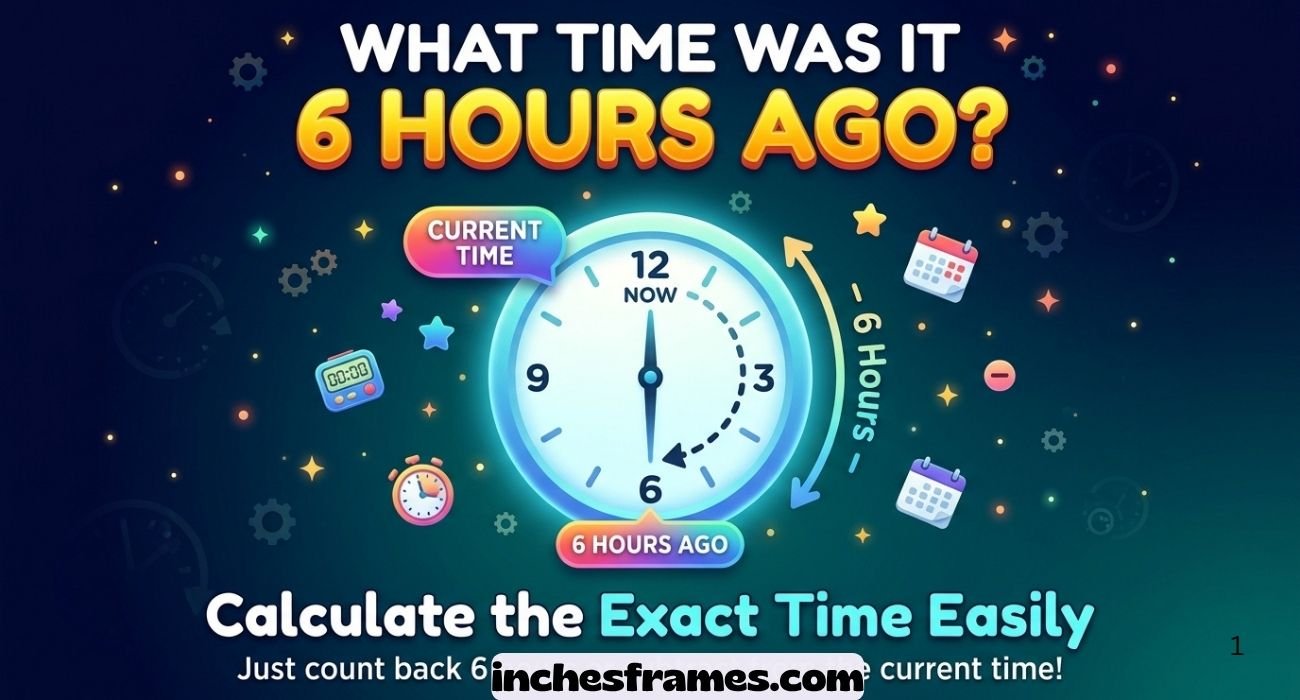
What Time Was It 6 Hours Ago? Calculate the Exact Time Easily
What time was it 6 hours ago? You can find the answer by subtracting six hours from your current local time. For example, if it is 2:30 PM now, six hours ago it was 8:30 AM on the same day. If it is 3:30 AM now, six hours ago it was 9:30 PM on the previous day.
Calculating a past time is simple when you know the current hour, minutes, and AM or PM designation. However, crossing midnight, changing dates, and comparing different time zones can make the answer less obvious. A small mistake can also lead to an incorrect timestamp.
This guide explains how to calculate what time it was six hours ago, with clear examples, a quick reference table, 12-hour and 24-hour clock conversions, and practical tips for using an hours ago calculator.
Understanding What Time Was It 6 Hours Ago
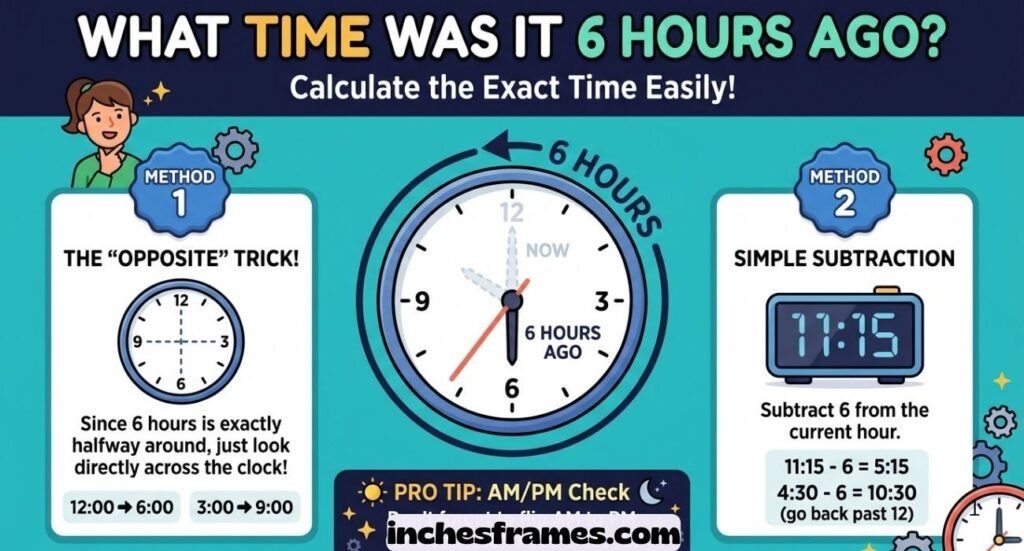
The phrase what time was it 6 hours ago refers to the exact clock time six hours before the present moment. To calculate it, subtract six hours from the current time while keeping the minutes unchanged.
For example, if the current time is 4:45 PM, subtracting six hours gives 10:45 AM. Both times have the same minutes, but the hour and AM/PM designation change.
Six hours equals 360 minutes or 21,600 seconds. These conversions help when you need to calculate elapsed time using minutes or seconds instead of hours.
The result depends on the starting time and location. If you are checking a clock in New York, the answer may differ from the displayed local time in Los Angeles. The elapsed duration remains six hours, but the local clock readings differ because the locations use different time zones.
Here are a few quick examples.
| Current time | Time six hours ago |
|---|---|
| 8:00 AM | 2:00 AM |
| 11:30 AM | 5:30 AM |
| 2:00 PM | 8:00 AM |
| 6:45 PM | 12:45 PM |
| 10:15 PM | 4:15 PM |
| 3:30 AM | 9:30 PM on the previous day |
| 12:20 AM | 6:20 PM on the previous day |
These examples show why checking the date matters. When the current time falls between midnight and 5:59 AM, subtracting six hours takes you into the previous calendar day.
How to Calculate 6 Hours Ago
You do not need a special tool to find the time six hours earlier. A clock, watch, phone, or simple calculation is enough.
Follow these three steps to determine the result accurately.
Step 1: Check the Current Time
Start by checking the current time on your device or clock. Record the hour, minutes, and AM or PM designation if you use the 12-hour clock.
For example, suppose your phone displays 7:25 PM. Your starting time is 7:25 in the evening.
Make sure the clock shows the correct local time. If you are calculating the time of an event in another location, check which time zone the event uses before beginning.
Step 2: Subtract Six Hours
Subtract six from the hour while keeping the minutes unchanged. Then adjust the AM/PM designation if the calculation crosses noon or midnight.
For example:
7:25 PM − 6 hours = 1:25 PM.
The minutes remain at 25 because you are subtracting six complete hours, not six hours and some additional minutes.
If the subtraction takes you below 1:00 AM, wrap around to the previous evening. For instance, 4:40 AM minus six hours equals 10:40 PM on the previous day.
Step 3: Check Whether the Date Changes
After calculating the time, check whether the result falls on the previous calendar day.
This step is especially useful when reviewing emails, work logs, travel records, and scheduled activities. A correct clock time with the wrong date can lead to confusion.
Consider this example:
The current time is 2:15 AM on October 21. Subtracting six hours gives 8:15 PM on October 20.
The result is not 8:15 PM on October 21 because the calculation moves backward across midnight.
For ordinary clock calculations, this method works well. For exact elapsed time across a daylight saving time transition, you should also consider the date, time zone, and applicable clock change.
Why People Search “What Was 6 Hours Ago From Now”
People often need to identify a past time without counting backward manually. Searching for what was 6 hours ago from now provides a quick way to understand when something happened.
For example, someone who receives a message at 4:00 PM may want to know what time it was six hours earlier. The answer is 10:00 AM on the same day.
The same calculation helps people review recent events, compare timestamps, and understand the timing of daily activities.
A person may need to determine when a shift started, when a customer submitted a request, or when a flight-related update appeared. In each situation, subtracting six hours gives a useful starting point.
However, the exact result must match the intended reference time. If you are reviewing a timestamp from another time zone, you should not assume that the time displayed on your device uses the same local clock.
Everyday Situations Where Time Six Hours Earlier Matters
Knowing how to calculate six hours ago can help with many everyday tasks. It is useful whenever you need to review an earlier event, check a schedule, or compare two times.
Work Shifts
Employees and managers may need to determine when a work shift began or when a task was completed. If an employee records an activity at 3:20 PM and wants to check the time six hours earlier, the result is 9:20 AM.
This calculation can help with reviewing attendance logs, work notes, and task histories. However, six hours before a recorded event does not automatically represent the official shift start time. Breaks, flexible schedules, and recorded clock-in times may affect the actual schedule.
For accurate records, use the original attendance or scheduling system whenever it is available.
Medication Schedule
A past-time calculation can help someone review a medication log and identify when a dose was recorded. For example, if a log shows a dose at 8:00 PM, six hours earlier was 2:00 PM.
The calculation only identifies a time. It does not establish when another dose should be taken. Medication timing depends on the specific instructions provided by a healthcare professional or the product label.
Use the recorded time and prescribed schedule rather than assuming that every medication follows a six-hour interval.
Sleep Tracking
People often review sleep and wake-up records to understand their daily routines. Subtracting six hours from a recorded wake-up time can help identify an earlier reference point.
For example, if someone wakes up at 7:15 AM, six hours earlier was 1:15 AM. This may help when reviewing a sleep log, although it does not prove that the person fell asleep at that time.
Sleep tracking devices can record different events, such as bedtime, estimated sleep onset, and waking. These measurements should not be treated as interchangeable.
Customer Support
Customer support teams often review timestamps to understand when a customer contacted them or when a request changed.
Suppose a support ticket shows an update at 5:40 PM. Six hours earlier was 11:40 AM, assuming both times use the same time zone and date reference.
This can help an employee search a log or compare related updates. For systems that store timestamps in UTC and display them in local time, the team should confirm the time zone before comparing records.
Flight Schedules
Travelers may need to review an earlier departure time, arrival update, or booking notification. If a flight-related event is recorded at 8:30 PM, six hours earlier is 2:30 PM on the same day when both times use the same local clock.
Air travel requires extra care because departure and arrival locations may use different time zones. A flight that departs in one time zone and arrives in another can show a local arrival time that looks earlier or later than expected.
When checking actual flight schedules, use the airport’s local time and the airline’s official information. Subtracting six hours alone cannot account for time zone differences or flight duration.
See Also ; How Long Until 4:00 PM? Calculate the Exact Time Remaining Today
Time Arithmetic Made Simple
Time arithmetic means adding or subtracting hours, minutes, and seconds to find another point in time. The basic calculation is straightforward because each hour contains 60 minutes and each minute contains 60 seconds.
For six hours, the conversion is:
- 6 hours = 360 minutes.
- 6 hours = 21,600 seconds.
- 1 hour = 60 minutes.
- 1 minute = 60 seconds.
When subtracting exactly six hours from a clock time, you only need to change the hour and account for any crossing of noon or midnight. The minutes and seconds stay the same.
For example, suppose the current time is 9:38:20 PM. Subtracting six hours gives 3:38:20 PM. The hour changes from 9 to 3, while the minutes and seconds remain unchanged.
The calculation becomes slightly different when you subtract a duration that includes minutes. If the starting time is 9:38 PM and you subtract six hours and 15 minutes, the result is 3:23 PM.
This distinction matters because a duration of six hours is not the same as a duration of six hours and 15 minutes.
For most everyday questions, the formula is simple:
Time six hours ago = Current time − 6 hours
For a future time, reverse the operation:
Time in six hours = Current time + 6 hours
These formulas work for ordinary clock arithmetic. If the calculation involves a daylight saving time change, a specific time zone, or a precise historical timestamp, the date and local time rules may also affect the displayed result.
Examples Using Both 12-Hour and 24-Hour Clock
The United States commonly uses the 12-hour clock, which labels time with AM and PM. Many digital systems and professional settings also use the 24-hour clock.
Both formats can represent the same moment. The main difference is how the hour is written.
12-Hour Clock
The 12-hour clock uses numbers from 1 through 12. AM generally identifies times from midnight until before noon, while PM identifies times from noon until before midnight.
To calculate six hours earlier, subtract six hours and check whether the result crosses noon or midnight.
| Current time | Six hours ago |
|---|---|
| 9:00 AM | 3:00 AM |
| 12:30 PM | 6:30 AM |
| 2:45 PM | 8:45 AM |
| 5:20 PM | 11:20 AM |
| 8:10 PM | 2:10 PM |
| 1:15 AM | 7:15 PM on the previous day |
| 5:50 AM | 11:50 PM on the previous day |
The AM/PM label matters because the same numerical hour can represent two different times. For example, 8:00 AM and 8:00 PM are 12 hours apart.
Always check the complete time rather than subtracting numbers without considering the AM/PM designation.
24-Hour Clock
The 24-hour clock represents a day using numbers from 00:00 through 23:59. It does not require AM or PM because each hour has a unique number.
For example, 2:00 PM becomes 14:00, while 8:00 PM becomes 20:00. Midnight is written as 00:00 at the start of a new day.
| Current time | Six hours ago |
|---|---|
| 08:00 | 02:00 |
| 12:30 | 06:30 |
| 14:45 | 08:45 |
| 17:20 | 11:20 |
| 20:10 | 14:10 |
| 01:15 | 19:15 on the previous day |
| 05:50 | 23:50 on the previous day |
The 24-hour format makes it easier to compare times without confusing AM and PM. It is useful in travel schedules, work records, digital logs, and other situations where clear timestamps matter.
Remember that 00:00 represents midnight, while 12:00 represents noon. This distinction prevents many common time calculation errors.
What Time Will It Be in 6 Hours?
To find what time it will be in six hours, add six hours to the current time instead of subtracting them.
For example, if it is 9:00 AM now, six hours later will be 3:00 PM. If it is 10:30 PM now, six hours later will be 4:30 AM on the following day.
The calculation is:
Future time = Current time + 6 hours
The minutes remain unchanged when you add exactly six hours. However, the date may change if the calculation passes midnight.
| Current time | Time in six hours |
|---|---|
| 6:00 AM | 12:00 PM |
| 9:15 AM | 3:15 PM |
| 2:40 PM | 8:40 PM |
| 7:30 PM | 1:30 AM on the next day |
| 11:45 PM | 5:45 AM on the next day |
This calculation is useful for planning appointments, estimating when a task will finish, and checking upcoming events.
It is different from calculating a time six hours ago. Subtraction moves backward, while addition moves forward. If you need the exact time for a scheduled event in another location, account for that location’s time zone before relying on the result.
Time Zones Can Change Everything
Time zones determine the local clock time used in different parts of the world. The United States spans several major time zones, including Eastern, Central, Mountain, and Pacific time.
As a result, two people can check their clocks at the same moment and see different local times. This does not mean that time itself has passed differently for them. Their clocks simply use different local time standards.
For example, when it is noon in New York, it is generally 9:00 AM in Los Angeles during periods when the usual three-hour difference applies.
If someone in New York wants to know what time it was six hours ago, the answer must be calculated using the relevant New York time. Someone in Los Angeles performing the same calculation will see a different local clock reading, even though both calculations refer to the same elapsed duration.
Daylight saving time can make these calculations more complicated. Some locations move their clocks forward or backward during the year, while others do not. The time difference between two locations can therefore change seasonally.
A six-hour subtraction across a daylight saving transition requires more care than ordinary clock arithmetic. For example, a local clock may skip an hour when clocks move forward or repeat an hour when clocks move backward. The date, location, and time zone rules determine the correct result.
When calculating time across locations, follow these steps:
- Identify the time zone associated with the original timestamp.
- Determine whether the calculation uses elapsed time or local clock arithmetic.
- Account for the applicable date and daylight saving rules.
- Convert the final result to the desired local time zone if necessary.
This method is particularly useful for international meetings, flight schedules, remote work, and online events.
Technology Depends on Accurate Time Calculation
Digital devices use time information for more than displaying the hour. Phones, computers, websites, email systems, and online applications often use timestamps to organize events and track activity.
A timestamp records when an event occurred or when a system registered it. Subtracting six hours from a timestamp can help you search for related events, review a message history, or understand when an update happened.
However, not every system displays time in the same way. Some applications store timestamps in Coordinated Universal Time (UTC) and convert them into local time when showing them to users. Others display the time zone selected in an account or device setting.
This can create confusion when two systems display different clock readings for the same event. Before calculating what time something happened, check whether both timestamps use the same time zone.
Accurate timekeeping also matters when reviewing scheduled events, digital records, and countdown timers. A countdown may depend on the device clock, a server clock, or a fixed event timestamp. If the underlying time is incorrect, the displayed result may also be incorrect.
For ordinary personal calculations, a correctly set phone clock is usually sufficient. For important records or events involving multiple locations, use the original timestamp and its time zone whenever possible.
Using an Hours Ago Calculator
An hours ago calculator helps you find a past time without performing the subtraction manually. It is useful when you need a quick result or want to calculate several different durations.
A basic time calculator usually requires a starting time and the number of hours to subtract. Some tools also let you enter a date, include minutes, or select a time zone.
To calculate six hours ago, enter the current time and choose six hours as the duration. The calculator then returns the earlier time. If the result falls on the previous day, a reliable date-aware calculator should also show the correct date.
For example, entering 4:25 AM and subtracting six hours produces 10:25 PM on the previous day. A calculator that only displays the hour without identifying the date may leave out important information.
A useful calculator should distinguish between subtracting a duration and finding a future time. It should also handle AM/PM correctly and account for date changes.
If you are working with an important timestamp, verify the time zone and date before accepting the result. An ordinary calculator may perform basic clock arithmetic correctly but may not account for daylight saving transitions.
You can also use a clock diagram to understand the process visually. Start at the current time and move backward by six hours. The ending point represents the earlier clock time, while the date tells you whether the calculation crossed midnight.
For a simple calculation, the manual method remains reliable. A calculator is most helpful when you need to work with several durations, dates, or locations.
Common Mistakes People Make
Subtracting six hours is simple, but several mistakes can lead to an incorrect answer. Most errors involve the date, AM/PM designation, minutes, or time zone.
Forgetting the Date
The most common mistake is finding the correct earlier clock time but assigning it to the wrong date.
For example, 4:00 AM minus six hours equals 10:00 PM on the previous day. Writing 10:00 PM on the current day gives the wrong timestamp.
Always check whether the subtraction crosses midnight. This is especially important when reviewing work logs, flight records, or scheduled events.
Mixing Up AM and PM
AM and PM distinguish morning from afternoon and evening in the 12-hour clock system. Confusing them can change the result by 12 hours.
For example, six hours before 8:00 PM is 2:00 PM, not 2:00 AM. The correct answer comes from subtracting six hours and checking where the result falls within the day.
Remember that 12:00 AM is midnight and 12:00 PM is noon.
Changing the Minutes
When subtracting exactly six hours, the minute value stays the same.
For example, 5:25 PM minus six hours equals 11:25 AM. Changing the result to 11:00 AM would remove 25 minutes that were never part of the calculation.
Minutes change only when the duration includes additional minutes or when you are performing a different calculation.
Ignoring Time Zones
A clock reading from one location may not match the clock reading in another. If you compare timestamps without checking their time zones, you may calculate the wrong relationship between events.
For example, a message recorded in New York and a response recorded in California should be compared using their respective time zones. Convert both timestamps to a common reference before determining the elapsed duration.
Confusing Six Hours Ago With Six Hours From Now
These phrases describe opposite calculations.
Six hours ago means subtract six hours from the current time. Six hours from now means add six hours.
If the current time is 3:00 PM, six hours ago was 9:00 AM, while six hours from now will be 9:00 PM.
Check whether you are looking for a past or future time before performing the calculation.
See Also ; How Long Until 2:30 PM? Countdown Timer and Time Calculation Guide
Why Relative Time Feels Different From Exact Time
People often describe events using phrases such as “a few hours ago,” “earlier today,” or “this morning.” These expressions are useful in casual conversation, but they do not identify an exact timestamp.
For example, saying that a meeting happened six hours ago gives a duration but not the specific clock time unless the reference time is known. If the current time is 8:30 PM, the meeting time was 2:30 PM, assuming ordinary elapsed-time calculation without a relevant clock transition.
Exact time calculations help remove this uncertainty. They allow people to compare events, review records, and plan activities using a clear reference point.
Relative time can also feel different because people do not always remember the duration of an event accurately. A busy afternoon may seem shorter than it was, while waiting for an appointment may feel longer. These impressions do not change the mathematical result.
A clock or time calculator provides a consistent way to find the earlier time. For important records, the best approach is to use the original timestamp, confirm the relevant time zone, and calculate the duration from that reference.
Frequently Asked Questions
What time was it 6 hours ago from now?
Subtract six hours from your current local time. If it is 2:00 PM now, six hours ago was 8:00 AM. The exact answer depends on the current time and the location or time zone you are using.
How do I calculate six hours before the current time?
Check the current hour and minutes, subtract six from the hour, and keep the minutes unchanged. Adjust the AM/PM designation and check whether the result falls on the previous day.
How many minutes are in six hours?
Six hours contain 360 minutes because each hour has 60 minutes. The calculation is 6 × 60 = 360. Six hours also equal 21,600 seconds.
Does subtracting six hours change the date?
Yes, when the starting time is early enough in the morning. For example, 3:00 AM minus six hours equals 9:00 PM on the previous day. Always check the date when the calculation crosses midnight.
5. How do I calculate six hours ago in military time?
Subtract six from the current hour in the 24-hour clock format. For example, 18:30 minus six hours equals 12:30. If the current time is 02:30, the result is 20:30 on the previous day.
6. What is the difference between six hours ago and six hours from now?
Six hours ago refers to a time in the past, so you subtract six hours. Six hours from now refers to a future time, so you add six hours. For a current time of 4:00 PM, the results are 10:00 AM and 10:00 PM, respectively.
Can time zones affect a six-hour calculation?
Yes. Time zones affect the local clock time used to represent an event. Daylight saving changes can also affect local clock calculations. For accurate comparisons, check the date, time zone, and whether you are calculating elapsed time or local clock time.
Can I use an online calculator to find what time it was six hours ago?
Yes. Enter the starting time and subtract six hours. If the calculation crosses midnight, make sure the calculator shows the correct date. For events in different locations, use a tool that supports time zones.
Does the minute value change when I subtract six hours?
No. When you subtract exactly six hours, the minutes and seconds remain unchanged. For example, 9:42 PM minus six hours equals 3:42 PM. The minutes change only if the duration includes additional minutes or seconds.
What time was it six hours ago if it is midnight now?
If it is exactly 12:00 AM, six hours earlier was 6:00 PM on the previous calendar day. In the 24-hour clock, this is 18:00 on the previous day.
Conclusion
To calculate what time was it 6 hours ago, subtract six hours from the current time, keep the minutes unchanged, and check whether the result crosses noon or midnight. For example, if it is 7:30 PM now, six hours ago it was 1:30 PM. If it is 3:30 AM, the answer is 9:30 PM on the previous day.
For everyday calculations, this simple method is usually enough. When reviewing flight schedules, digital records, or events across different locations, also confirm the date and time zone. These checks help you find the correct earlier time without confusing AM and PM or assigning the result to the wrong day.